

Quick answer: NCLEX SATA questions feel harder because they ask you to make five or six independent decisions instead of one, and because the exam never tells you how many options are correct. But the scoring changed: select-all-that-apply items are no longer all-or-nothing. NCSBN now scores them with a plus/minus model, so each correct selection earns a point and each incorrect selection costs one, with the total never dropping below zero. That single change flips the correct strategy. Selecting everything you half-suspect now scores worse than selecting only what you can defend.
What are NCLEX SATA questions?
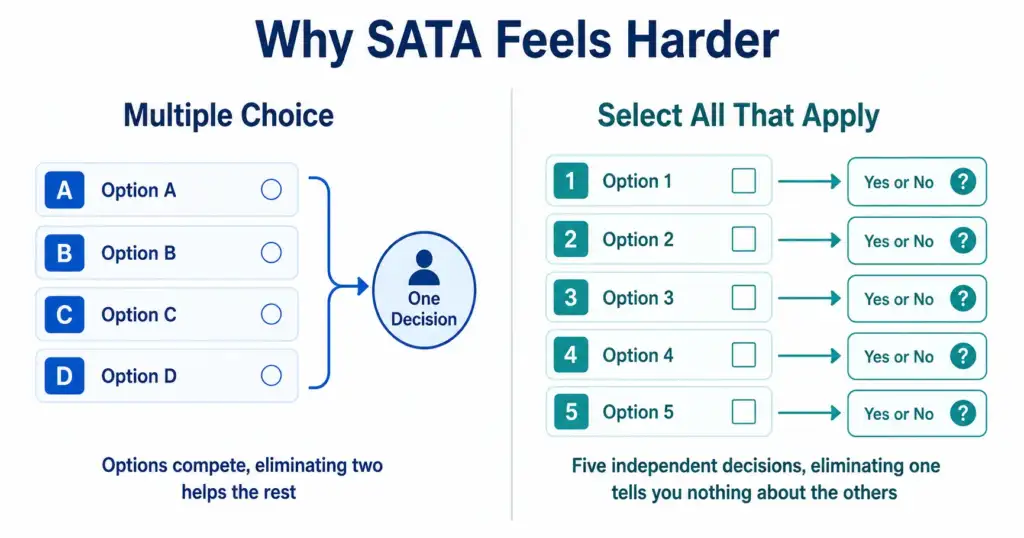
NCLEX SATA questions give you five or six options and asks you to choose every correct one. Anywhere from two options to all of them may be right, and the question gives you no hint about the number.
That is the whole difficulty. A standard multiple-choice item asks one question. NCLEX SATA questions ask five or six separate true-or-false questions and score them together.
NCLEX SATA questions appear throughout the exam, both as standalone items and inside Next Generation NCLEX case studies. According to NCSBN, multiple response select-all-that-apply items are scored using a polytomous method that allows partial scoring — which is the detail most candidates are still getting wrong.
How are NCLEX SATA questions scored now?
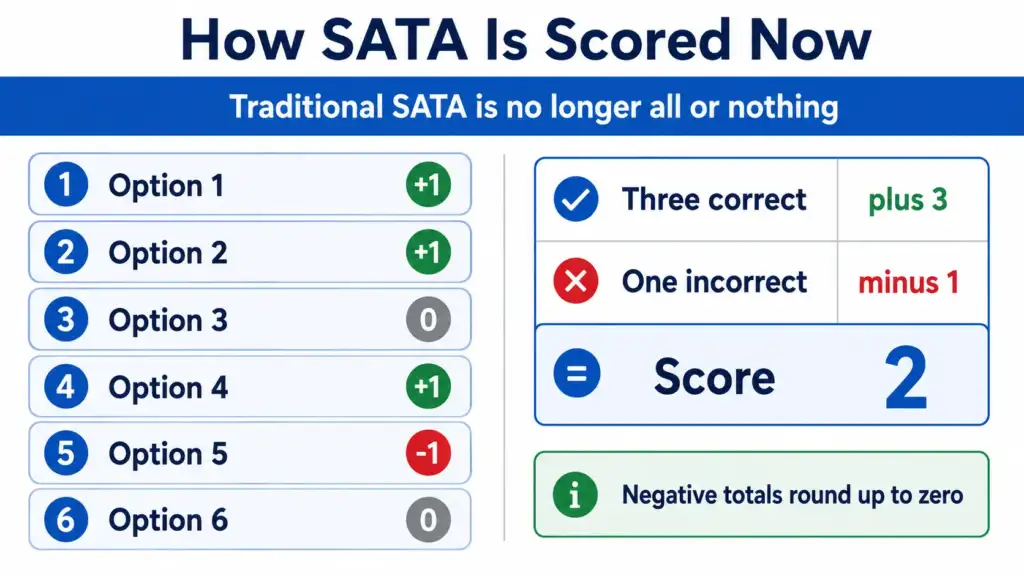
This is the part worth reading twice, because the scoring of NCLEX SATA questions changed and most study advice has not caught up.
Before Next Generation NCLEX, SATA items were all-or-nothing. Select four of five correct options and miss one, and you earned zero. Select all five correct plus one wrong, and you earned zero. There was no middle ground, and that is where SATA’s fearsome reputation came from.
That is no longer how it works. NCSBN confirms that traditional multiple-response select-all-that-apply items are now scored using the plus/minus (+/−) method, which allows partial scoring to reflect partial understanding.
Here is the mechanic:
- Each correct option you select earns +1
- Each incorrect option you select costs −1
- Correct options you leave unselected earn 0 — no penalty for missing one
- The total for the item cannot go below zero
A worked scoring example
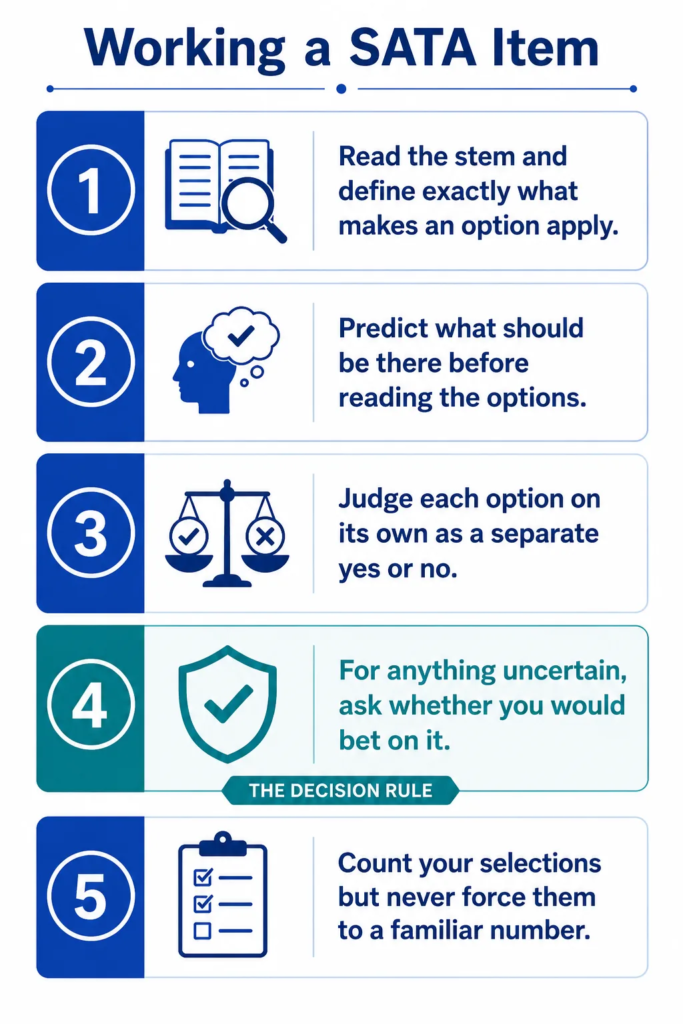
Six options. Four are correct.
| Your strategy | Correct picked | Incorrect picked | Score |
|---|---|---|---|
| Selected all six options | 4 | 2 | 2 |
| Selected only the three you were sure of | 3 | 0 | 3 |
| Selected the four correct options | 4 | 0 | 4 |
| Selected four correct plus one wrong | 4 | 1 | 3 |
Look at rows one and two.
Selecting everything scored worse than selecting only what you were certain about. The candidate who picked all six got every correct answer — and still finished a point behind the candidate who picked three and stopped.
That is the whole strategy for NCLEX SATA questions in one table.
Not every multiple-response item is scored the same way
One caution before you build a rule around this. NCSBN uses three scoring methods for items with more than one key: zero/one, plus/minus, and rationale scoring. Which one applies depends on the item.
Items that say “Select three” or otherwise specify a number generally use zero/one scoring — you get the point only if your set is exactly right. Items that say “Select all that apply” use plus/minus.
You cannot reliably tell from looking at the screen which model is running behind an item. Which leads to a convenient conclusion: the safest behaviour is identical either way. Select only what you can defend. That is optimal under plus/minus and it is optimal under zero/one.
More on how NGN item types are built and scored: Next Generation NCLEX Explained and NCLEX Case Studies Explained.
Why NCLEX SATA questions feel harder than they are
Six decisions, not one. Every one of these items multiplies the work. Each option is a separate judgment. Six independent decisions take roughly six times the cognitive effort of one, and that fatigue accumulates across a five-hour exam.
No answer count. Standard items reassure you that exactly one option is right. NCLEX SATA questions withhold that anchor, and uncertainty is uncomfortable in a way that has nothing to do with difficulty.
No elimination strategy. On a four-option multiple-choice item, ruling out two wrong answers gets you halfway. On a SATA item, ruling out one option tells you nothing about the other five.
The old reputation persists. Most candidates were taught that SATA is all-or-nothing, because for years it was. That belief drives the over-selection habit — if I have to get them all, I had better pick everything that might be right — which is now actively costing points.
They often cluster. Two or three in a row is common and feels like the exam is punishing you. It isn’t. Item selection is adaptive but not vindictive.
The one strategy that changes your score on NCLEX SATA questions
Select only what you can defend.
Not what might be right. Not what sounds reasonable. What you could justify to a colleague if they asked why.
Under plus/minus scoring, every uncertain selection is a coin flip that can cancel out a correct answer you already earned. Three confident selections beat six hopeful ones, every time.
This is uncomfortable, and that is why most candidates ignore it. Leaving an option unselected feels like giving up a point. It isn’t — unselected correct options cost you nothing. Wrong selections are the only thing that subtracts.
Listen: Prioritization 2026 NCLEX Review — ASK GRAPHH, Episode 76, on the NCLEX High Yield Podcast
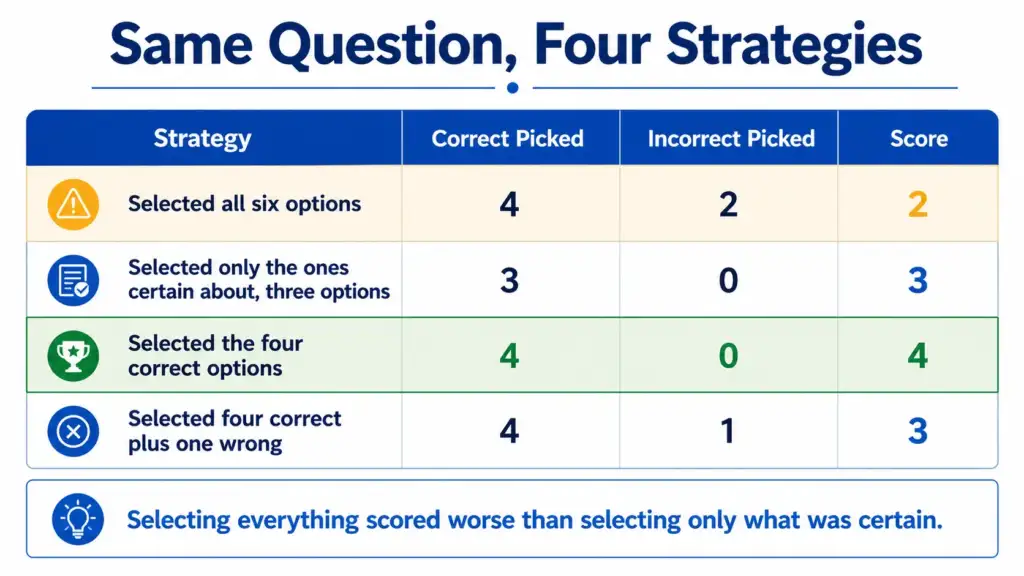
How to approach NCLEX SATA questions in five steps
One — cover the options and read the stem alone. Every one of these items starts here. Identify the patient, the condition, and precisely what is being asked. Answer sets are designed to pull you toward plausible-sounding options before you have decided what the question wants.
Two — treat each option as a separate true-or-false question. Do not compare options against each other. There is no “best” answer here, only correct ones and incorrect ones. Comparing is a multiple-choice habit and it actively hurts you.
Three — mark each option Yes, No, or Unsure. Be honest at this step. Unsure means unsure, not “probably.”
Four — select every Yes. Leave every No. Leave most Unsures. This is the discipline. If you can articulate a clinical reason, it becomes a Yes. If your reason is “it sounds right,” it stays unselected.
Five — do not revisit. Once you have decided, move on. The NCLEX does not let you return to previous items, and second-guessing on a computerized adaptive test costs time you need later.
Applying the same process to every item is what separates a reliable method from instinct — the same principle behind NCLEX Test Taking Strategies 2026.
Watch: Dr. Zeeshan’s METHOD — how to attack any NCLEX question
A worked example

A client is admitted with acute pancreatitis. Which nursing actions should the nurse include in the plan of care? Select all that apply.
- Maintain the client NPO
- Position the client supine and flat
- Administer prescribed analgesia
- Monitor serum amylase and lipase
- Encourage a high-fat diet to maintain calories
- Assess for signs of hypocalcemia
Work each one independently, the way you should work every one of these items.
1. NPO — Yes. Resting the pancreas is foundational. Defensible. 2. Supine and flat — No. Side-lying with knees flexed, or sitting leaning forward, relieves pain. Flat worsens it. 3. Analgesia — Yes. Pancreatitis pain is severe and treating it is standard. 4. Amylase and lipase — Yes. These are the diagnostic markers. 5. High-fat diet — No. Fat stimulates pancreatic enzyme release. This is the opposite of care. 6. Hypocalcemia — Yes. Fat necrosis binds calcium; hypocalcemia is a recognised complication.
Answer: 1, 3, 4, 6.
Now the strategic point. Suppose you were confident about 1, 3, and 4, but unsure about 6 and could not recall the calcium link. Selecting only 1, 3, and 4 earns 3 points. Adding 6 as a guess earns 4 if you are right, or 2 if you are wrong.
But suppose instead you had been unsure about 2 and included it defensively. Now you score 4 minus 1, or 3 — you gave back the very point you were protecting.
That asymmetry is why over-selection fails on NCLEX SATA questions.
Common traps on NCLEX SATA questions
Selecting everything plausible. The most expensive habit on NCLEX SATA questions. The single most expensive habit, and it comes directly from the outdated all-or-nothing belief.
Assuming there must be at least three. There is no minimum. Two can be correct. So can all six.
Comparing options against each other. Each stands alone. “Better than option 3” is not a reason to select option 4.
Missing absolutes. Always, never, all, and only inside an option usually make it false — though not reliably enough to answer on autopilot.
Assuming a wrong guess is free. It is not. Under plus/minus, it subtracts.
Panicking at a cluster. Several in a row is normal. It says nothing about how you are performing.
An extra difficulty if you trained outside the U.S.
Internationally educated nurses face two additional loads on NCLEX SATA questions.
Volume of reading. Six options plus a stem is a great deal of text under time pressure. If you are reading in a second language, NCLEX SATA questions consume disproportionate time even when your clinical reasoning is sound.
Scope creep. Several options will describe things you genuinely do on your unit but that fall outside U.S. RN scope, or that require an order you have not been told exists. Each option must be judged against American practice, not your own.
More on that gap: Why Internationally Educated Nurses Fail the NCLEX and NCLEX Delegation Questions: What U.S. Scope of Practice Assumes.
Frequently Asked Questions
Find out whether SATA is really your problem
Most candidates who struggle with NCLEX SATA questions do not have a SATA problem. They have a content problem that these items expose, because an item requiring six independent judgments has six opportunities to reveal a gap that a single-answer question would have hidden.
If you have already tested, you can find out which it is. Your Candidate Performance Report shows performance by content area and by clinical judgment step — whether you are missing cues, ranking poorly, or choosing wrong interventions.
Submit your CPR for analysis on the NCLEX High Yield website — Dr. Zeeshan or Nurse Brittany will read it and tell you what to fix first. Free.
Or text us at 725-444-7551. Monday–Friday, 8am–5pm PST.
Building a plan from scratch? Start with our 12-week NCLEX study plan for internationally educated nurses, or go straight to live course schedules · 30-Day Prep Course · 60-Day VIP Package · One-on-one tutoring
CPR reports must be dated within the preceding twelve (12) months. All interpretations are provided solely as professional opinion based on experience and subjective analysis, and do not represent, imply, or guarantee any association, endorsement, or affiliation with the NCLEX, NCSBN, or any related governing entities, nor should they be construed as predictive of examination outcomes.