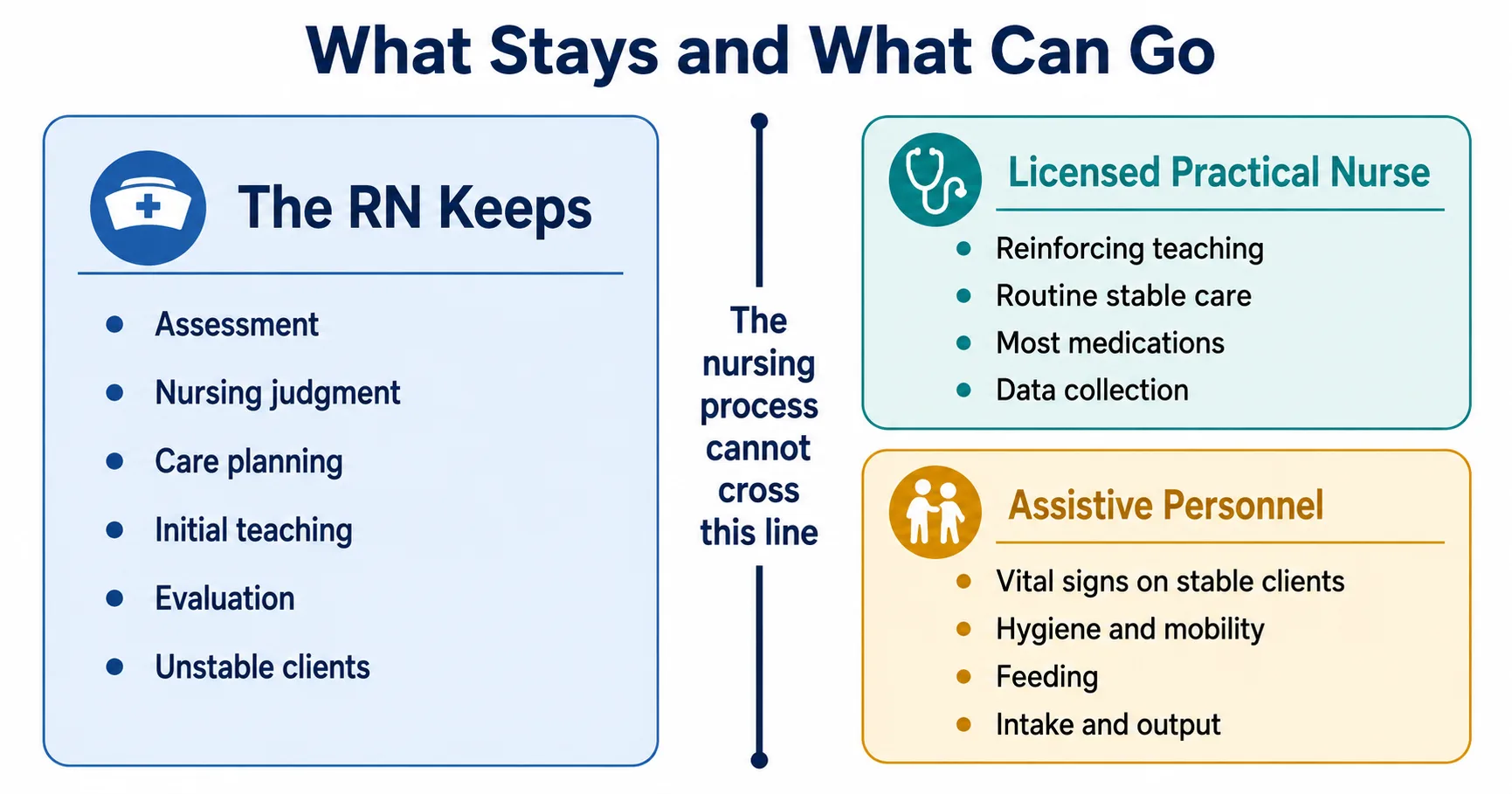

Quick answer: NCLEX delegation questions test whether you can match a task to the right team member under U.S. scope of practice rules — not whether you could do the task yourself. The governing rule comes from the NCSBN and ANA National Guidelines for Nursing Delegation: clinical reasoning, nursing judgment, and critical decision making can never be delegated. That means the RN keeps assessment, teaching, evaluation, and any unstable patient. Everything stable, routine, and predictable can move down the team. If you trained outside the United States, these questions are hard for one reason: they assume a staffing structure many countries do not use.
What are NCLEX delegation questions really testing?
They are not testing task difficulty. This is the misunderstanding that costs internationally educated nurses the most points.
A nursing assistant can safely feed a stable patient, and a task like that looks simple. But an LPN cannot perform the initial assessment on a newly admitted patient, and that task also looks simple. Difficulty is not the variable. Judgment is, and NCLEX delegation questions are built entirely around that distinction.
Every one of these items is asking the same underlying question: does completing this task require clinical reasoning? If yes, the RN keeps it. If no, and the patient is stable, it can be delegated.
NCLEX delegation questions sit inside the Management of Care category, which carries the heaviest weighting of any Client Needs area on the NCLEX-RN test plan. You cannot pass by guessing on them.
Delegation or assignment? The distinction most international nurses miss
The 2019 NCSBN and ANA National Guidelines for Nursing Delegation draw a line that shows up constantly in NCLEX delegation questions:
Delegation is transferring a nursing responsibility from a licensed nurse to a delegatee — an LPN/LVN or unlicensed assistive personnel — while the delegating nurse retains accountability.
Assignment is distributing work that already falls within someone’s own scope. A charge nurse giving patients to RNs is assigning, not delegating.
Here is the detail almost no review book emphasises: RNs do not delegate to other RNs. When an RN hands care to another RN, that is a transfer of care, and the receiving nurse becomes responsible for the patient.
When NCLEX delegation questions ask which client to assign to the LPN versus which to keep, they are testing scope. When they ask what to hand to a fellow RN, they are testing something different. Read the verb.
Who can you delegate to?
U.S. hospitals use a three-tier nursing team. Many countries do not, which is exactly why NCLEX delegation questions feel foreign. Before you can answer them, you need the tiers.
Registered Nurse (RN) — performs assessment, develops the care plan, provides initial teaching, evaluates outcomes, and manages unstable patients. The RN delegates and remains accountable for the outcome.
Licensed Practical or Vocational Nurse (LPN/LVN) — works under RN direction with stable, predictable patients. Can give most oral and many injectable medications, perform sterile dressing changes, insert catheters, suction established tracheostomies, monitor and reinforce teaching the RN has already delivered.
Unlicensed Assistive Personnel (UAP) — nursing assistants, CNAs, patient care technicians. Perform activities of daily living, bathing, feeding, ambulating, positioning, and collect routine data such as vital signs, intake and output, and weights on stable patients. A UAP may collect data. A UAP may never interpret it.
If you trained in a system without LPNs or UAPs, build these three tiers into memory before attempting practice questions. Guessing your way through NCLEX delegation questions without knowing the tiers is guessing twice.
The Five Rights of Delegation
NCSBN and ANA define five conditions that must all be met. NCLEX delegation questions are usually decided by the second one.
Right task — the activity falls within the delegatee’s job description and the facility’s written policies.
Right circumstance — the patient’s condition is stable and the outcome predictable. If the condition changes, the delegatee must report it and the nurse must reassess whether delegation is still appropriate.
Right person — the delegatee has demonstrated competence for this task with this patient, not merely a job description that lists it.
Right directions and communication — specific instructions covering what to do, for which patient, what to report back, and by when.
Right supervision and evaluation — the nurse follows up, evaluates the outcome, and remains accountable throughout.
When you are stuck on one of these items, check the second right first. In most NCLEX delegation questions, the deciding factor is patient stability, not the task itself.
The one rule that answers most NCLEX delegation questions
The guidelines state it plainly: clinical reasoning, nursing judgment, and critical decision making cannot be delegated.
Everything else follows. The RN keeps:
- Assessment — the initial or any new assessment. A UAP collects vital signs; the RN interprets them.
- Teaching — the first time any education is delivered. An LPN may reinforce teaching already given.
- Evaluation — judging whether an intervention worked.
- Unstable patients — anyone whose condition is changing or unpredictable.
- Anything requiring judgment — triage, care planning, clinical decisions.
Memorise this as a single phrase: assess, teach, evaluate, unstable. Applied honestly, it resolves the large majority of NCLEX delegation questions in seconds.
What each role can and cannot do
| Task | UAP | LPN/LVN | RN only |
|---|---|---|---|
| Bathing, feeding, ambulating, positioning | ✅ | ✅ | |
| Vital signs on a stable patient | ✅ | ✅ | |
| Intake and output, routine weights | ✅ | ✅ | |
| Oral and most injectable medications | ✅ | ||
| Sterile dressing change | ✅ | ||
| Urinary catheter insertion | ✅ | ||
| Suctioning an established tracheostomy | ✅ | ||
| Reinforcing teaching already given | ✅ | ||
| Initial admission assessment | ✅ | ||
| First-time patient teaching | ✅ | ||
| Evaluating response to an intervention | ✅ | ||
| Care plan development | ✅ | ||
| IV push medications | ✅ | ||
| Blood transfusion initiation | ✅ | ||
| Any unstable or newly admitted patient | ✅ |
Use this table as your reference point for NCLEX delegation questions. Scope varies by state and by facility policy. The exam tests the national standard, so answer from this table rather than from the rules where you currently work. That gap between local practice and the national standard is where most NCLEX delegation questions are lost.
Why these questions are harder if you trained outside the U.S.
Your system may have no equivalent tier. This is the root of most difficulty with NCLEX delegation questions. In many countries every bedside nurse holds the same licence. There is no delegatee, so there is no delegation decision, and the entire concept is new rather than merely unfamiliar.
You are used to doing everything yourself. In resource-limited settings, autonomy is survival. NCLEX delegation questions punish that instinct. Choosing to perform a task yourself when it should be delegated is scored as a wrong answer, even though it is safe and even though you would do it that way tomorrow morning.
Titles do not translate. A “sister” in one system is a charge nurse in another. A “staff nurse” abroad may hold responsibilities closer to a U.S. LPN, or closer to an RN, depending on the country. Do not map your local titles onto the exam’s roles.
Accountability sits differently. In the U.S. model, the delegating nurse remains accountable for the outcome. Delegation is not a transfer of blame, and answer options implying otherwise are distractors.
For more on how training background shapes exam performance, read Why Internationally Educated Nurses Fail the NCLEX.
How to answer NCLEX delegation questions in four steps
Step one — identify the verb. Delegate, assign, transfer, or supervise? Each means something different. “Assign to the LPN” is a scope question. “Which client should the charge nurse assign to the float RN” is not delegation at all.
Step two — check stability. Scan every option for instability: new admission, changing condition, post-procedure within the first hour, abnormal vital signs, anything acute. Unstable patients stay with the RN. This step alone eliminates most wrong options.
Step three — check for judgment. Does the task require assessing, teaching, evaluating, or deciding? If so, the RN keeps it regardless of who could physically perform it.
Step four — match to the lowest appropriate tier. Once you have removed the unstable and the judgment-dependent, delegate to the most junior person qualified. The exam rewards efficient, appropriate delegation, not RN heroics.
Run every one of these items through those four steps in order. A consistent process beats instinct, which is the same principle behind NCLEX Test Taking Strategies 2026.
A worked example
The nurse is caring for four clients. Which client should be assigned to the LPN?
A. A client admitted two hours ago with new-onset chest pain B. A client on day three after cholecystectomy, taking oral pain medication and ambulating C. A client newly diagnosed with diabetes who needs initial insulin teaching D. A client whose blood transfusion started ten minutes ago
The answer is B.
Option A is a new admission requiring initial assessment — RN. Option C is first-time teaching — RN. Option D is inside the highest-risk window of a transfusion, and initiation and monitoring in that period stay with the RN.
Option B is stable, predictable, and post-operative on oral medication. Nothing about it requires clinical judgment.
Notice that three of the four clients stay with the RN because of assessment, teaching, and stability — not because the tasks are technically difficult. That pattern repeats across almost all NCLEX delegation questions.
Under Next Generation NCLEX formats, NCLEX delegation questions appear as matrix grids and case studies as well as standard multiple choice. See NCLEX Case Studies Explained and How to Master Clinical Judgment for the NCLEX.
Listen: Prioritization 2026 NCLEX Review — ASK GRAPHH, Episode 76, on the NCLEX High Yield Podcast
Watch: Dr. Zeeshan’s METHOD — how to attack any NCLEX question
Common traps in NCLEX delegation questions
The task looks easy, so it must be delegable. Vital signs on an unstable patient are still an RN responsibility. Stability outranks simplicity every time.
Confusing reinforcing with teaching. An LPN may reinforce education the RN has already delivered. The first delivery is always RN.
Forgetting accountability. Delegating does not end your responsibility. Options suggesting the nurse “no longer needs to follow up” are wrong.
Delegating to an RN. RNs receive assignments and transfers of care, not delegation.
Answering from your own workplace. Whatever your unit permits, answer NCLEX delegation questions from the national standard.
If prioritisation questions are also giving you trouble, they share a root cause — read NCLEX Prioritization Questions When You Trained Outside the U.S.
Frequently Asked Questions
Find out whether delegation is actually your weak area
Many internationally educated nurses assume delegation is what sank them, and for a good number it genuinely is. But assuming is not the same as knowing, and rebuilding a study plan around the wrong weakness costs you an entire attempt.
If you have already tested, the evidence exists. Your Candidate Performance Report shows your performance in Management of Care and across every clinical judgment step.
Submit your CPR for analysis on the NCLEX High Yield website — Dr. Zeeshan or Nurse Brittany will read it and tell you what to fix first. Free.
Or text us at 725-444-7551. Monday–Friday, 8am–5pm PST.
Building your plan from scratch? Start with our 12-week NCLEX study plan for internationally educated nurses, or go straight to live course schedules · 30-Day Prep Course · 60-Day VIP Package · One-on-one tutoring
CPR reports must be dated within the preceding twelve (12) months. All interpretations are provided solely as professional opinion based on experience and subjective analysis, and do not represent, imply, or guarantee any association, endorsement, or affiliation with the NCLEX, NCSBN, or any related governing entities, nor should they be construed as predictive of examination outcomes.