

The NCLEX algorithm is the engine behind the most consequential examination in a nursing candidate’s professional career — and it is also one of the most widely misunderstood. Candidates arrive at the testing center with mental models of how the adaptive system works that are largely incorrect, and those incorrect models generate anxiety responses that are both unnecessary and cognitively costly. When difficult questions feel like failure signals, when an exam ending at 75 questions produces panic rather than calm, or when a run of uncertain answers triggers a spiral of self-doubt that impairs clinical reasoning on subsequent questions — these are the direct costs of misunderstanding the NCLEX algorithm.
Understanding how the NCLEX algorithm actually functions changes the exam experience in a measurable way. Candidates who know that question difficulty tracks their estimated competency level rather than their answer quality feel appropriately alert rather than threatened by difficult questions. Candidates who know that 75 questions indicates statistical certainty in either direction rather than a specific outcome stop trying to infer their result from the question count. Candidates who understand that the algorithm’s maximum information selection rule means the exam is continuously designed to challenge them at their ceiling stop interpreting that challenge as evidence of failure. This understanding does not change the clinical reasoning required to answer questions correctly — but it removes a significant source of in-exam anxiety that systematically degrades the clinical reasoning available.
This guide explains the NCLEX algorithm from the ground up: the psychometric framework it is built on, how it selects each question, how it continuously estimates the candidate’s competency level, what the passing standard actually is and how it relates to the ability estimate, how the exam termination decision is made, how the NGN formats introduced in 2023 affect the algorithm’s scoring model, and what the algorithm means for preparation strategy — specifically, what it is actually measuring and therefore what effective preparation must build.
The Psychometric Foundation: Item Response Theory
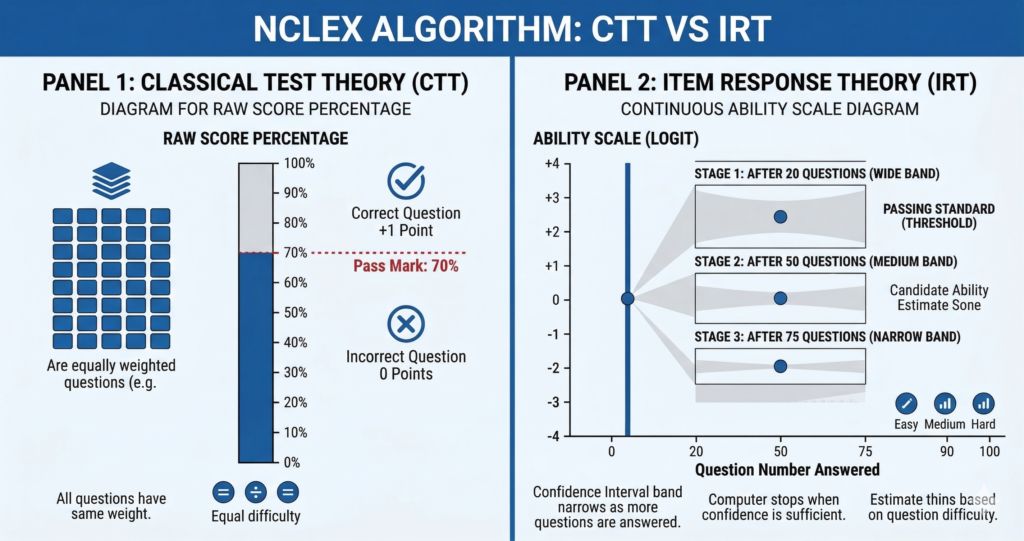
The NCLEX algorithm is built on Item Response Theory — a psychometric framework that is fundamentally different from the classical test theory that most candidates are familiar with from nursing school and standardized testing. Understanding this foundational difference explains why the NCLEX does not calculate a percentage score, why question difficulty adapts continuously, and why the exam can reach a defensible pass or fail determination with as few as 75 questions.
Classical Test Theory vs. Item Response Theory
Classical test theory — the framework behind most educational assessments — calculates ability as a function of raw score: the number of questions answered correctly divided by the total number of questions. A test score of 80 percent means 80 percent of questions were answered correctly. Ability is inferred from the proportion of correct responses, and all questions contribute equally to the score regardless of their difficulty. The NCLEX algorithm operates on a fundamentally different model. Item Response Theory does not count correct responses — it models the statistical relationship between a candidate’s underlying ability level and their probability of answering any specific question correctly, given that question’s mathematically characterized difficulty, discrimination, and guessing parameters. Every response the candidate makes provides information about the probability distribution of where their true ability level lies, and the NCLEX algorithm continuously updates its estimate of that distribution rather than tallying a score.
The Three Item Parameters
Each question in the NCLEX item pool has three mathematically characterized properties that the NCLEX algorithm uses to extract ability information from every response. The difficulty parameter describes the ability level at which a candidate has a 50 percent probability of answering the question correctly — a high-difficulty question requires a high ability level to have even a coin-flip chance of answering correctly. The discrimination parameter describes how sharply the question distinguishes between candidates at different ability levels — a high-discrimination question produces very different response probabilities for candidates slightly above and slightly below the question’s difficulty level, making it highly informative about a candidate’s exact position on the ability scale. The guessing parameter accounts for the probability that a candidate with very low ability selects the correct answer by chance, which affects the statistical interpretation of a correct response at the lowest ability levels. The NCLEX algorithm uses all three parameters simultaneously when it extracts ability information from each response — which is why a single well-characterized question can provide more ability information than multiple poorly characterized questions of equal apparent difficulty.
The Ability Estimate and Its Confidence Interval
After each response, the NCLEX algorithm updates its estimate of the candidate’s ability level and the confidence interval around that estimate. The ability estimate is a point on a continuous scale — expressed in logit units — that represents the algorithm’s current best estimate of the candidate’s true competency level. The confidence interval is a range around that estimate that reflects the statistical uncertainty about the estimate’s precision: a wider confidence interval means the algorithm is less certain about the ability estimate’s exact value; a narrower one means greater precision. With each additional response, the confidence interval narrows — not uniformly, but proportional to how much information each question provides about the ability estimate’s exact value. The NCLEX algorithm terminates the exam when the confidence interval has narrowed sufficiently for the algorithm to determine with the required statistical certainty whether the ability estimate falls above or below the passing standard — not when a specific number of questions has been answered.
How the NCLEX Algorithm Selects Each Question

The question selection mechanism of the NCLEX algorithm is what produces the adaptive exam experience — the sense that questions are getting harder when performance is strong and easier when performance is weak. Understanding this mechanism precisely replaces anxiety-inducing misinterpretations with accurate clinical understanding of what is happening.
Maximum Information Selection
After each response, the NCLEX algorithm selects the next question from the available item pool using a rule called maximum information selection: the question chosen is the one that provides the most statistical information about the candidate’s ability level at their current estimated position on the ability scale. In practical terms, this means the algorithm selects questions whose difficulty level is closest to the candidate’s current ability estimate — because questions matched to a candidate’s ability level produce the most information about whether the true ability is slightly above or slightly below the current estimate. Questions that are much easier than the current estimate would almost certainly be answered correctly and would provide minimal information about the upper boundary of the candidate’s competency. Questions much harder than the current estimate would almost certainly be answered incorrectly and would provide minimal information about where exactly the competency ceiling lies. The maximum information rule keeps the NCLEX algorithm continuously targeting the questions most likely to narrow the confidence interval efficiently.
Why Difficult Questions Are a Sign of Good Performance
The maximum information rule produces one of the most important — and most frequently misunderstood — features of the NCLEX algorithm: a candidate who is performing above the passing standard will consistently receive difficult questions throughout the session. Because the algorithm targets questions at the candidate’s current ability estimate, and because answering questions correctly shifts the ability estimate upward, a consistently correct-answering candidate will receive progressively more difficult questions as the estimate climbs. The experience of a challenging exam session — where most questions feel genuinely difficult and uncertain — is the experiential signature of above-standard performance being tracked by the NCLEX algorithm. The incorrect interpretation of this experience as failure evidence is both understandable and costly: it triggers an anxiety response that impairs the clinical reasoning needed to continue performing well. The accurate interpretation — that difficult questions are the algorithm responding to strong performance — is not only less anxiety-producing but is simply correct.
Question Cycling and Content Balancing
While maximum information selection drives the primary question selection rule, the NCLEX algorithm also operates under content balancing constraints that ensure the final item set represents the full NCSBN test plan content distribution. These constraints prevent the algorithm from concentrating all selected questions in a single content area — regardless of where the maximum information rule would point, the algorithm must deliver a proportional distribution of questions across safe and effective care environment, health promotion, psychosocial integrity, and physiological integrity subcategories. Content balancing means that a candidate may receive a question in a content area where their ability estimate is high — not because that question provides maximum information about the overall ability estimate but because the test plan content balance requires representation from that category. Candidates occasionally experience shifts from very difficult questions to apparently easier ones mid-session that are explained by content balancing rather than by ability estimate change.
The Passing Standard and How It Determines Your Result
The passing standard is the fixed reference point on the NCLEX algorithm’s ability scale against which every candidate’s ability estimate is compared. Understanding precisely what it is, how it was established, and how it relates to the exam termination decision removes the most common sources of result-misinterpretation anxiety.
A Criterion-Referenced Standard, Not a Competitive Cutoff
The NCLEX algorithm uses a criterion-referenced passing standard — a fixed ability level determined by clinical expert judgment to represent minimum safe competency for entry-level nursing practice — rather than a norm-referenced standard that places candidates in competition with each other. A norm-referenced standard would set the passing cut score at a percentile rank relative to how the current cohort performs, meaning that a fixed proportion of candidates would always pass regardless of their absolute competency level. The criterion-referenced standard means the passing rate fluctuates based on the actual competency distribution of each testing cohort relative to the fixed clinical standard — if a given cohort is collectively well-prepared, more will pass; if preparation is weaker across the cohort, fewer will pass. The NCLEX algorithm is not grading on a curve. The passing standard reflects the minimum clinical judgment competency that NCSBN expert panels have determined is necessary for safe entry-level nursing practice, and that standard does not move based on how other candidates perform.
How the Passing Standard Is Set
The passing standard on the NCLEX algorithm is established through a structured criterion-setting process conducted by NCSBN expert panels at regular intervals. Panels of practicing nurses, nursing educators, and clinical specialists independently evaluate representative exam items and estimate the probability that a minimally competent entry-level nurse would answer each correctly. These estimates are aggregated using validated criterion-setting methodology to derive the ability level that represents the minimum clinical competency threshold. The standard was most recently reviewed and maintained in the transition to the Next Generation NCLEX format in 2023. When the standard is updated — which the NCSBN announces in advance — all candidates sitting the exam after the effective date are assessed against the new standard. The NCLEX algorithm compares each candidate’s ability estimate to whichever standard is in effect at the time of their examination.
The Three Termination Conditions
The NCLEX algorithm terminates the exam when one of three conditions is satisfied. First condition: the confidence interval around the ability estimate falls entirely above the passing standard, meaning the algorithm is statistically confident the candidate’s true competency is above the threshold — the exam ends as a passing result. Second condition: the confidence interval falls entirely below the passing standard, meaning the algorithm is statistically confident the candidate’s true competency is below the threshold — the exam ends as a failing result. Third condition: the maximum item count of 150 questions is reached without the confidence interval having achieved the required statistical precision in either direction — the algorithm uses the final ability estimate value relative to the passing standard to make a determination based on the preponderance of evidence accumulated across all 150 items. The minimum item count of 75 exists because the algorithm requires a minimum number of responses before any confidence interval can be narrow enough to satisfy the termination criterion — it is not a content coverage minimum but a statistical precision minimum.
What the Question Count Means — and Does Not Mean
No feature of the NCLEX algorithm generates more candidate anxiety and more misinformation in nursing communities than the question count. A precise understanding of what the question count actually reflects — and what it does not reflect — removes the most pervasive source of in-exam misinterpretation.
75 Questions: Statistical Efficiency in Either Direction
A candidate who receives 75 questions has produced a response pattern that allowed the NCLEX algorithm to achieve the required statistical certainty about their ability level after the minimum item count. This can happen in either outcome direction. A candidate who has answered questions consistently well above the passing standard produces an ability estimate whose confidence interval rapidly climbs above the threshold — the algorithm achieves pass certainty efficiently because the consistent evidence strongly locates the ability estimate above the standard. A candidate who has answered questions consistently below the passing standard produces the opposite — rapid downward confidence interval movement that achieves fail certainty just as efficiently. The question count of 75 is a measure of how quickly the NCLEX algorithm achieved statistical certainty — not a measure of which direction that certainty pointed. Both passing and failing results occur at 75 questions with high frequency.
150 Questions: Prolonged Statistical Uncertainty
A candidate who receives 150 questions produced a response pattern that kept the NCLEX algorithm’s confidence interval straddling the passing standard threshold for the entire available item pool. This most commonly occurs when a candidate’s performance is variable — answering questions in some content areas or at some difficulty levels well above the standard while answering others near or below it — producing an ability estimate that repeatedly crosses the passing threshold as new evidence accumulates. It can also occur when a candidate’s true ability is very close to the passing standard, making statistical certainty about whether they are above or below it inherently more information-intensive to achieve. Receiving 150 questions is not evidence of below-standard performance — it is evidence that the NCLEX algorithm required its full evidence-collection capacity to make a certain determination about a candidate whose performance was close to or variable around the passing threshold. Many candidates who receive 150 questions pass.
The Myth That More Questions Means Failing
The persistent myth that more questions means failing and fewer questions means passing contains a partial statistical truth that is distorted into a misleading rule. The truth: candidates with very strong, consistent above-standard performance tend to produce efficient confidence interval convergence above the threshold, which terminates the exam earlier. The distortion: this correlation is treated as a causal rule that any exam ending early indicates passing. The NCLEX algorithm is a statistical inference process, not a linear scoring system. Variable performance near the passing standard produces longer exams regardless of whether the final determination is passing or failing. Consistency of performance relative to the passing standard — not performance quality in absolute terms — is what drives exam length. A candidate who performs consistently but consistently near the passing standard may receive more questions than a candidate with more variable but overall stronger performance. The question count is observable information that has no reliable directional interpretation during the exam. The only actionable response to any question count awareness is to apply clinical reasoning to the next question and proceed.
How the NGN Formats Changed the NCLEX Algorithm’s Scoring Model
The Next Generation NCLEX formats introduced in 2023 changed the NCLEX algorithm’s scoring model in a specific and clinically important way — from purely dichotomous item scoring to a mixed model that includes polytomous scoring for specific NGN item types. Understanding this change explains why partial credit exists for some items and what it means for how candidates should engage with those formats.
Dichotomous Scoring for Traditional Items
Traditional NCLEX algorithm items — single best answer, ordered response, fill-in-the-blank calculation, and traditional SATA — use dichotomous scoring: a response is either fully correct or incorrect, contributing a binary signal to the ability estimate. The ability information extracted from a dichotomous item is the probability of the observed response given the candidate’s current ability estimate and the item’s parameters. A correct response to a high-difficulty item provides strong upward evidence for an above-standard ability estimate; an incorrect response to a low-difficulty item provides strong downward evidence for a below-standard estimate. Dichotomous items contribute a single information unit — correct or incorrect — to the NCLEX algorithm’s running ability estimate regardless of how close the candidate came to the correct answer.
Polytomous Scoring for NGN Items
Extended multiple response, matrix questions, and some implementations of bow tie questions use polytomous scoring in the NCLEX algorithm — scoring models that award credit on a continuum based on the degree of correctness rather than requiring complete accuracy for any credit. For extended multiple response items, partial credit is awarded based on the number of correct options selected relative to the total correct options available — selecting four of five correct options earns more credit than selecting two of five, even if neither earns full marks. For matrix questions, partial credit may be awarded per row or per cell. Polytomous scoring contributes a richer ability signal to the NCLEX algorithm than dichotomous scoring — rather than a binary correct or incorrect update to the ability estimate, it provides a graded update that reflects the degree of clinical judgment accuracy demonstrated. This richer signal means that thoughtful, deliberate engagement with every option in a polytomous item contributes meaningfully to the ability estimate even when complete accuracy is not achieved. Candidates who disengage from ambiguous options in extended multiple response items — selecting only the clearly correct ones and leaving the uncertain ones — are contributing weaker ability signals than candidates who carefully evaluate every option and make a considered determination for each.
Unfolding Case Study Scoring Independence
The six questions in an unfolding case study set are scored independently by the NCLEX algorithm — each question contributes a separate ability update regardless of how previous questions in the set were answered. This scoring independence has a preparation and in-exam implication: a reasoning error on question three of an unfolding case study does not penalize questions four through six. The NCLEX algorithm treats each item in the set as a discrete evidence unit for the ability estimate, not as a connected scoring chain where early errors cascade forward. This means that a candidate who is uncertain about their answer on question two should approach question three with full clinical reasoning confidence rather than deflated confidence from the previous item’s uncertainty. Each question in the set is a fresh ability measurement opportunity regardless of the set’s internal reasoning continuity.
What the NCLEX Algorithm Means for Preparation Strategy
Understanding the NCLEX algorithm is not merely an intellectual exercise — it has direct, specific implications for how preparation should be structured and what it must build to produce above-standard performance on an adaptive examination.
The Algorithm Measures Competency, Not Content Coverage
The most important preparation implication of the NCLEX algorithm is what it is actually measuring. It is not measuring how many clinical facts the candidate has memorized or how many practice questions they have completed. It is measuring whether the candidate’s clinical competency — their ability to apply clinical reasoning to novel scenarios across all weighted content areas simultaneously — reliably falls above the criterion-referenced passing standard. This means that preparation optimized for broad content familiarity — studying every topic to a level of recognition — produces a different kind of readiness than preparation optimized for clinical reasoning competency — studying the highest-weight content areas deeply enough to apply them correctly under clinical scenario conditions. The NCLEX algorithm will not reward recognition without application; its adaptive question selection specifically targets the ability level where the candidate’s reasoning begins to show uncertainty, which exposes the gaps between familiarity and genuine competency. Effective preparation builds retrievable, applicable clinical reasoning rather than recognizable clinical facts.
Consistency Across Content Areas Matters More Than Peak Performance in Any One
Because the NCLEX algorithm uses content balancing to ensure representative coverage of all test plan categories, and because the confidence interval must be on one side of the passing standard across the full weighted content distribution — not just in the candidate’s strongest areas — consistent above-standard performance across all categories is more valuable than exceptional performance in some categories with below-standard performance in others. The algorithm will deliver questions from every content category regardless of where the ability estimate currently sits in any specific area. A candidate with exceptional cardiovascular and respiratory performance but below-standard pharmacology performance will encounter pharmacology questions that push the confidence interval toward the passing standard, potentially offsetting strong performance in other areas. The preparation implication is the one that smart preparation frameworks consistently emphasize: closing below-standard weak areas is more preparation-critical than deepening already-strong areas.
What Passes the Algorithm Is Clinical Judgment, Not Clinical Knowledge
The NCLEX algorithm is specifically designed to measure clinical judgment — the ability to recognize clinically significant data, analyze what it indicates, prioritize hypotheses, generate appropriate solutions, take the correct action, and evaluate outcomes. This is why the Next Generation NCLEX formats were introduced: to provide item types that assess clinical judgment at a structural level that traditional multiple choice cannot reach. A candidate who has built a clinical knowledge base through passive content review and question volume without deliberate clinical reasoning development may have sufficient content knowledge to recognize correct answers in familiar contexts but insufficient clinical judgment to produce correct answers in novel or complex ones. The NCLEX algorithm’s adaptive difficulty tracking will find the ceiling of clinical reasoning competency regardless of how extensive the content knowledge base is. The preparation that reliably produces above-standard performance on the NCLEX algorithm is active, retrieval-based clinical reasoning development — not passive content accumulation.
- Algorithm implication 1 — Prepare for difficulty: Training under timed, challenging clinical scenario conditions during preparation habituates clinical reasoning to function under the cognitive load the NCLEX algorithm will consistently deliver. Preparation that avoids difficulty produces clinical reasoning that degrades precisely where the algorithm targets it.
- Algorithm implication 2 — Maintain all content areas: The content balancing constraint means below-standard performance in any content area will contribute below-standard ability updates to the running estimate regardless of how well other areas perform. Maintain all content areas above 50 percent practice accuracy before the exam.
- Algorithm implication 3 — NGN engagement matters more than completion: Polytomous scoring means that thoughtful engagement with every option in NGN items produces stronger ability signals than rushing to select the obvious correct options. Preparation that builds independent evaluation habits for every option in extended multiple response and matrix items directly improves the ability signal these items contribute.
Algorithm implication 4 — Simulation stamina is a scoring variable: The NCLEX algorithm collects ability evidence across the full exam session. Clinical reasoning quality that degrades in the final third of a long session produces below-standard ability updates late in the exam that can offset strong early performance. Weekly full simulation sessions build the cognitive stamina that keeps reasoning quality consistent across 75 to 150 questions.
Conclusion
The NCLEX algorithm is a precisely designed psychometric system built to answer one clinical question: does this candidate’s competency reliably fall above the minimum threshold for safe entry-level nursing practice? Item Response Theory provides the statistical framework. Maximum information question selection keeps the exam continuously targeting the candidate’s competency ceiling. The criterion-referenced passing standard sets the clinical threshold. The confidence interval termination rule determines when sufficient statistical certainty has been achieved. Polytomous scoring for NGN formats enriches the ability signal that clinical judgment items contribute. The exam length reflects the statistical efficiency of the evidence — not a signal about the outcome direction.
Candidates who understand the NCLEX algorithm interpret their exam experience accurately: difficult questions are signals of strong performance, variable question difficulty reflects the algorithm tracking a variable response pattern, and any question count from 75 to 150 is the result of the algorithm’s statistical process rather than a verdict on the candidate’s preparation quality. This accurate understanding removes the anxiety misinterpretations that impair clinical reasoning during the exam and replaces them with the informed calm that allows every question to be answered with the full reasoning capacity that preparation has built. Study what the algorithm measures — clinical judgment applied to clinical scenarios — build it through deliberate retrieval-based practice, and the adaptive system designed to find your ceiling will find it above the passing standard.
