

NCLEX exam day logistics are the category of preparation that most candidates think about last and should think about much earlier. The clinical preparation — practice questions, content review, simulation sessions — rightly dominates the preparation period. But arriving at the testing center to discover that the identification document brought does not match the ATT name format, that the testing center requires different identification than expected, or that the appointment was scheduled for the wrong Pearson VUE location is not a clinical preparation failure — it is a logistics failure that can delay or prevent the exam regardless of clinical readiness. These failures are entirely preventable, and preventing them requires nothing more than completing the logistics checklist at the right time before the exam.
Beyond the registration and scheduling mechanics, NCLEX exam day preparation involves a set of physical and cognitive preparation decisions in the 24 hours before and the morning of the exam that have meaningful effects on the clinical reasoning performance the exam requires. Sleep, nutrition, the morning routine, the arrival window, and the physical setup at the testing station all contribute to the physiological and cognitive state that enters the first question. A candidate who arrives at the testing center after a poor night of sleep, having skipped breakfast, rushing because they left late, and sitting down to the tutorial in a cortisol-elevated stress state is starting the exam at a cognitive disadvantage that clinical preparation cannot compensate for.
This guide covers the complete NCLEX exam day logistics framework: the registration and authorization process from nursing school graduation through ATT receipt, the Pearson VUE scheduling process and the decisions it requires, what to bring and what not to bring to the testing center, the testing center environment and what to expect during check-in and throughout the session, the physical and cognitive preparation protocol for the 48 hours before the exam, the morning-of routine that produces the optimal physiological state for the first question, and the post-exam process for accessing results.
Step 1: Applying for Licensure and Receiving Your ATT
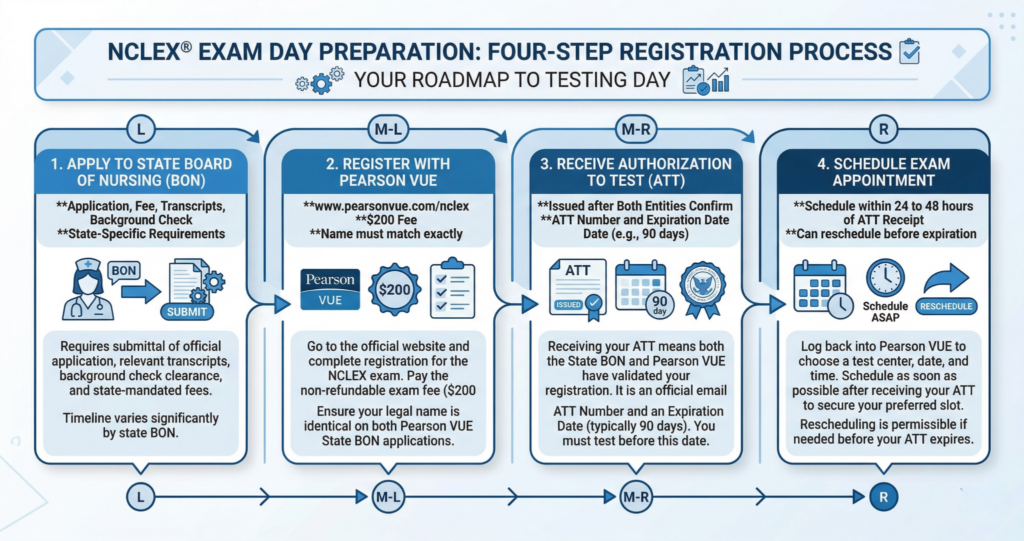
The NCLEX exam day begins with a registration and authorization process that must be completed correctly before any scheduling can occur. The process involves two separate actions with two separate entities: applying for licensure with the state board of nursing and registering for the NCLEX with Pearson VUE.
Applying to Your State Board of Nursing
The first step toward NCLEX exam day is submitting an application for registered nurse licensure to the state board of nursing in the state where you intend to practice. Every state has its own application process, application fee, and processing timeline — and these vary significantly. Some states process applications within days; others take three to six weeks. The application typically requires proof of nursing program completion or an anticipated graduation date, official transcripts from the nursing program, a background check authorization and fee, and completion of any state-specific requirements such as jurisprudence examinations or additional documentation. Applications submitted before graduation are accepted by most states with a conditional processing status — the authorization to test will not be issued until the state board confirms degree conferral. Check the specific state board of nursing website for the current requirements and processing timeline rather than relying on peer information or program guidance that may not reflect the current year’s requirements.
Registering With Pearson VUE
After applying to the state board, register for the NCLEX with Pearson VUE at pearsonvue.com/nclex. Registration requires creating a Pearson VUE account if one does not already exist, selecting the NCLEX-RN (or NCLEX-PN), paying the examination fee of 200 dollars as of 2026, and providing accurate personal information that exactly matches the state board application. The name entered in the Pearson VUE registration must match the name on the state board application and the identification document that will be presented at the testing center — even minor discrepancies between these three records can cause check-in problems on NCLEX exam day. If your legal name includes a middle name, confirm whether both the state board application and Pearson VUE registration use the same format — full middle name, middle initial only, or no middle name — and ensure the identification document matches.
Receiving the Authorization to Test
The Authorization to Test is issued by Pearson VUE after both the state board of nursing has approved the application and Pearson VUE has confirmed registration and fee payment. The ATT is an email document containing a candidate identification number and an eight-digit ATT number that is required to schedule the NCLEX exam day appointment. The ATT has an expiration date — typically 90 days from issuance, though this varies by state — and the exam must be scheduled and completed before this expiration. A common NCLEX exam day logistics error is receiving the ATT and delaying scheduling, allowing the ATT to expire and requiring reapplication. The correct approach is to schedule the exam appointment within 24 to 48 hours of receiving the ATT, selecting the target date based on preparation readiness benchmarks. If readiness benchmarks are not yet met at the time of ATT receipt, schedule the appointment for the target date anyway — appointments can be rescheduled before the ATT expires if preparation requires additional time.
Step 2: Scheduling Your NCLEX Exam Day Appointment
Scheduling the NCLEX exam day appointment involves several decisions beyond simply selecting a date — the testing center location, the appointment time, and the preparation-date relationship all affect exam day performance in ways that logistical guidance rarely addresses.
Choosing the Testing Center Location
Pearson VUE testing centers are distributed across most metropolitan and suburban areas, and in most regions multiple testing centers are accessible within a reasonable distance. When selecting a testing center for NCLEX exam day, prioritize three factors over proximity alone. First, verify that the specific testing center administers the NCLEX — not all Pearson VUE centers administer nursing examinations, and some centers administer other licensing examinations only. The Pearson VUE scheduling interface will show only eligible centers for the NCLEX-RN. Second, consider the commute reliability on exam day — a testing center that is slightly further but accessible by a reliable route without traffic uncertainty produces a lower pre-exam cortisol response than a closer center accessible only through a high-traffic corridor where unexpected delays could produce a rushed arrival. Third, conduct a practice drive or transit run to the testing center before NCLEX exam day — ideally at the same time of day as the scheduled appointment — to confirm travel time, parking availability, and the center’s physical location relative to the address.
Choosing the Appointment Time
The appointment time for NCLEX exam day has a meaningful effect on cognitive performance that most scheduling guidance ignores. Human cognitive performance — specifically working memory capacity and clinical reasoning speed — follows a circadian pattern that peaks in the late morning for most people, typically between 9 AM and noon. The NCLEX tests clinical reasoning at the upper boundary of the candidate’s competency, which means performance is most consistently reliable when cognitive capacity is at its daily peak. Candidates who typically perform best cognitively in the morning should schedule a morning NCLEX exam day appointment — 8 AM or 9 AM slots — whenever available. Candidates whose cognitive peak is consistently later in the day should schedule accordingly. The worst NCLEX exam day appointment time for most candidates is early afternoon, when the post-lunch energy dip commonly coincides with mid-session fatigue in a long exam. If only afternoon slots are available, a lighter lunch with protein emphasis and no heavy carbohydrates reduces the post-lunch cognitive dip.
The Four-Week Scheduling Rule
A practical NCLEX exam day scheduling principle is the four-week rule: schedule the exam four weeks from the date of ATT receipt, then evaluate whether that date is appropriate based on readiness benchmark progress at the two-week checkpoint. If all four readiness benchmarks are on track at two weeks before the scheduled date, proceed with the appointment. If one or more benchmarks are not on track, reschedule the appointment to four to six weeks later and apply the targeted intervention protocols for the remaining gaps. The four-week initial scheduling ensures that a target date is in place without pressure, the appointment can be rescheduled at no cost if done within Pearson VUE’s rescheduling window (typically 24 to 30 hours before the appointment), and preparation is oriented toward a specific endpoint rather than toward indefinite open-ended preparation.
What to Bring and What Not to Bring on NCLEX Exam Day

The testing center check-in process on NCLEX exam day has specific identification, documentation, and personal item requirements that differ from most other testing environments. Understanding them before arrival eliminates check-in delays and the anxiety of uncertainty during the most high-stakes arrival experience in a nursing candidate’s professional life.
Required Identification
Pearson VUE requires two forms of identification on NCLEX exam day, of which the primary identification must meet specific criteria. The primary identification must be government-issued, include a photograph, include a signature, and be printed in English or include an official English translation. The most commonly used primary identification is a driver’s license, state-issued identification card, or passport. The name on the primary identification must exactly match the name on the ATT — including the format of any middle name or initial. Secondary identification must include a signature and may be a credit card, debit card, or other identification with a signature. Bring the ATT as a printed document or accessible on a phone as backup — the candidate ID number it contains is the check-in reference number, and having it immediately accessible at check-in avoids a delay while a proctor retrieves the registration by name. Do not rely on memory for the ATT number.
What Is Not Allowed in the Testing Room
The NCLEX exam day testing environment is strictly controlled. No personal items are allowed in the testing room — bags, wallets, phones, watches, jewelry beyond simple studs, and outer layers of clothing beyond one layer may need to be removed or stored in a locker provided by the testing center. Specific items that are commonly brought and must be stored include: all electronic devices including smartwatches and fitness trackers, headphones or earbuds, food or beverages except water in a clear container in some centers (check the specific testing center’s policy), medical devices beyond what is documented and approved in advance with Pearson VUE’s accommodation request process, and any written notes or study materials. Earplugs are typically provided by the testing center for candidates who want them and do not need to be brought. The testing room provides a dry-erase board or scratch paper for calculations, and a proctor will escort the candidate through security measures including palm vein scanning or fingerprinting at most testing centers.
The NCLEX Exam Day Document Checklist
- ATT: Printed or accessible on phone. Contains candidate ID number needed for check-in. Do not arrive without this.
- Primary ID: Government-issued photo ID with signature in English. Name must exactly match ATT name format — including middle name presence, absence, or initial format.
- Secondary ID: Signed credit or debit card, or other signed identification.
- Directions and parking information: Confirmed in advance. Do not rely on live navigation on exam morning — confirm the route and parking the day before.
- Water: Clear container only. Check the specific testing center’s policy on beverages in the waiting area versus testing room.
- Comfortable layered clothing: Testing centers are typically cool. A cardigan or light layer that can be removed if warm is useful — but check the specific center’s clothing policy regarding outer garments.
The Testing Center Environment: What to Expect
Familiarity with the NCLEX exam day testing center environment reduces the novelty anxiety that an unfamiliar environment produces. Most of the physical and procedural features of the testing environment are consistent across Pearson VUE centers, and knowing what to expect converts potential surprises into confirmed expectations.
The Check-In Process
Arrive at the testing center 30 minutes before the scheduled NCLEX exam day appointment time — not 10 minutes before. The 30-minute buffer serves two functions: it eliminates the cortisol spike that a close-arrival generates, and it provides time for the check-in process without clock pressure. Check-in at most Pearson VUE centers involves presenting identification, having photographs taken, providing a palm vein scan or fingerprint, reviewing and signing testing policies, and being escorted to the testing room. The check-in process typically takes 10 to 15 minutes. Candidates who arrive 30 minutes early complete check-in with time to sit quietly in the waiting area before being called to the testing station — using this time for silent 4-7-8 breathing and the pre-exam grounding sequence rather than reviewing notes or discussing the exam with other candidates in the waiting area.
The Testing Station Setup
The NCLEX exam day testing station is a private workstation separated from adjacent stations by dividers or partitions, equipped with a computer monitor, keyboard, and mouse, a dry-erase board or note-taking materials and a marker, and hearing protection (earplugs or headphones) available from the proctor on request. The room is monitored by cameras and by proctors who move through the testing area. The room temperature is typically cool — cooler than most home environments — which promotes alertness but may feel uncomfortably cold for some candidates, making the light layered clothing suggestion practically relevant. The tutorial period before the first question begins allows candidates to familiarize themselves with the interface navigation, the on-screen calculator, and the question flag feature. Use the tutorial period entirely for the pre-exam grounding sequence — breathing cycles, desk anchor, process-focus mantra — rather than rushing through it to begin the exam questions.
Breaks During the NCLEX Exam Day Session
The NCLEX provides the opportunity for optional breaks during the exam session — typically available after a minimum number of questions have been answered, at defined question count intervals, or at any point the candidate chooses to pause. Two important facts about NCLEX exam day breaks that many candidates do not know until exam day. First, the five-hour exam clock does not stop during breaks — the break time is consumed from the total available exam time. A five-minute break consumes five minutes from the remaining exam time. This is not a reason to avoid breaks if a break is needed — a five-minute cognitive and physiological reset that restores reasoning quality is worth five minutes of exam time — but it should be factored into pacing rather than treated as free time outside the exam. Second, leaving the testing room requires checking out with a proctor and checking back in with the same biometric verification — the process takes several minutes in addition to the break itself. Plan breaks to include sufficient time for the check-out and check-in process rather than only the break activity.
The 48-Hour NCLEX Exam Day Preparation Protocol
The 48 hours before NCLEX exam day are the final preparation window — and the most important preparation activity in this window is not clinical content review. It is the physical and cognitive preparation that determines the physiological state entering question one.
48 Hours Before: The Final Preparation Session
Two days before NCLEX exam day, complete the final meaningful clinical preparation session: 40 to 50 practice questions with full rationale review, a brief review of the reasoning error log for any persistent error types, and a final engagement with the NCSBN official NGN sample questions for format calibration. This session confirms that clinical reasoning competency is accessible and active two days before the exam. After this session, clinical preparation is complete. The remaining 48 hours are not for additional content study — the marginal preparation value of any content activity in this window is negligible relative to the physiological preparation value of the alternative use of this time. No new content should be introduced, no weak areas should be revisited in the belief that one more review session will solidify them, and no additional practice sessions should be completed after this final session.
The Night Before NCLEX Exam Day
The night before NCLEX exam day has one overriding priority: sleep. Sleep deprivation produces measurable increases in amygdala reactivity — making anxiety responses larger and harder to regulate — and measurable decreases in prefrontal cortex function — making clinical reasoning slower and less reliable. The cognitive cost of eight hours of sleep the night before the exam significantly outweighs the marginal preparation value of any alternative use of that time. Get into bed at a time that allows eight hours of sleep before the exam morning alarm. The evening routine before bed should include a real meal with protein and complex carbohydrates — not a rushed snack — an enjoyable activity completely unrelated to nursing, and the logistics confirmation checklist: ATT accessible, identification confirmed to match ATT name format, route and parking confirmed, alarm set for the correct time, outfit selected and laid out. After this checklist is complete, engage in deliberate cognitive disengagement from nursing content until morning. The preparation is done.
NCLEX Exam Day Morning Protocol
The morning of NCLEX exam day should be structured to produce cognitive activation without over-arousal — bringing the brain from sleep state to exam-ready alertness while avoiding the anxiety spike that unstructured pre-exam morning time commonly produces. Wake up with enough time for a genuine morning routine without any rushing — rushing activates the threat-response system and elevates cortisol before the exam has begun. Eat a real breakfast with protein and complex carbohydrates — sustained glucose release prevents the mid-exam blood glucose dip that impairs reasoning quality in the latter exam blocks. Hydrate well before leaving home. Include 10 minutes of brisk walking or gentle movement — this reduces pre-exam cortisol more reliably than stillness and activates the physiological state associated with alert engaged cognition. Do not review notes, flashcards, or practice questions on exam morning. Engage the process-focus mantra during the commute — this question, this reasoning, now — and arrive at the testing center 30 minutes before the appointment time as planned.
After NCLEX Exam Day: Results, Scoring, and Next Steps
The post-exam period after NCLEX exam day involves waiting for results, understanding how results are reported, and planning next steps based on the outcome. Understanding the result access process before exam day prevents the confusion and additional anxiety that uncertainty about results timing can produce.
Quick Results and Official Results
Pearson VUE offers a Quick Results service that provides unofficial pass or fail results approximately two business days after NCLEX exam day for a fee of approximately eight dollars. Quick Results is available in most states but not all — check the NCSBN website or the state board website for whether Quick Results is available in the licensure state. Quick Results are described as unofficial because they are not confirmed by the state board of nursing — the official licensure result is issued by the state board, which may take several days to several weeks depending on the state’s processing timeline. Most states participate in the NCLEX Quick Results service, and for candidates in participating states who want the earliest possible result access, Quick Results is the standard approach. The official result — the actual license — is confirmed by the state board and typically verified through the state board’s license verification database, which is updated when the board processes the examination result.
If the Result Is Passing
A passing result on NCLEX exam day initiates the state board’s licensure process — confirming the result, issuing a license number, and adding the license to the state’s verification database. The timeline from passing result to active license varies by state from one day to several weeks. Most employers require a license number or verification before a nurse can begin clinical practice in an independent capacity, making the state board database check the most practical way to confirm that the license is active and available for employment verification. After receiving confirmation of a passing result, allow genuine acknowledgment of the achievement — the clinical knowledge, preparation discipline, and psychological resilience that passing the NCLEX represents is worth marking consciously rather than immediately rushing to licensure next steps.
If the Result Is Not Passing
A not-passing result after NCLEX exam day requires a mandatory waiting period of 45 days before retesting. The NCSBN issues a Candidate Performance Report to candidates who do not pass, which categorizes performance in each content category relative to the passing standard. The CPR is the most valuable document available for a repeat candidate’s preparation planning — it identifies which specific areas fell below the passing standard on the actual exam, which is more accurate preparation intelligence than any diagnostic practice assessment. Before scheduling a retake, review the CPR carefully with the gap-type classification framework: are below-standard categories reflecting content knowledge gaps, clinical reasoning application gaps, or both? The preparation approach for the retake should be structurally different from the preparation that preceded the first attempt — the same approach applied longer rarely produces a different result. Many nurses pass on a second or third attempt and go on to full, rewarding nursing careers. The NCLEX exam day result is one event in a professional life, not a fixed measure of clinical competency.
- Quick Results timeline: Available approximately two business days after NCLEX exam day through Pearson VUE for approximately 8 dollars. Unofficial confirmation only — official result from state board follows.
- License verification: Check the state board of nursing’s license verification database to confirm active license status before beginning employment. Most boards update within days to weeks of a passing result.
- CPR access: Candidates who do not pass receive the Candidate Performance Report from NCSBN within a few days of the result. This document is the foundation of all repeat candidate preparation planning.
- Retake scheduling: The 45-day waiting period begins the day of the failed exam. Register with Pearson VUE and apply for a new ATT before the waiting period ends to minimize the delay between the earliest eligible retake date and the actual retake appointment.
Conclusion
NCLEX exam day logistics are the preparation category where the highest-consequence mistakes are also the most preventable. The registration sequence — state board application, Pearson VUE registration, ATT receipt, appointment scheduling — requires accurate name consistency across all documents and timely scheduling before ATT expiration. The check-in requirements — two forms of matching identification, ATT accessible, no personal items in the testing room — are non-negotiable and verifiable in advance. The 48-hour preparation protocol — final clinical session 48 hours before, no content review in the final 24 hours, sleep as the priority the night before, cognitive activation without over-arousal the morning of — produces the physiological state that allows clinical preparation to express itself as clinical performance.
The logistics preparation that this guide covers takes a total of approximately two hours to complete across the preparation period — far less time than any clinical content session — and prevents failures that are entirely independent of clinical competency. Complete the registration sequence correctly from the beginning, schedule promptly after ATT receipt, confirm identification document names match before exam week, verify the testing center location and route in advance, and execute the 48-hour preparation protocol with the same discipline applied to clinical preparation. The exam is where clinical competency is demonstrated. Logistics preparation ensures that nothing prevents the demonstration.
