

NCLEX YouTube channels have become a genuine preparation resource in 2026 — not a replacement for a quality question bank and rationale review system, but a meaningful supplement that makes complex clinical content more accessible, more memorable, and more clinically applicable than textbook reading alone for many candidates. The challenge is that the quality range across NCLEX YouTube channels is enormous. Some channels deliver clinically accurate, NGN-aligned, conceptually organized content by educators with genuine examination expertise. Others deliver high-production-value videos that are engaging to watch but clinically superficial, outdated relative to the current exam format, or organized around nursing school success rather than NCLEX clinical reasoning development specifically.
Using the wrong NCLEX YouTube channels is not a neutral preparation choice — it is a preparation cost. A candidate who spends three hours per week watching content that teaches clinical facts without the reasoning frameworks the exam tests is investing preparation time that would have been better directed toward active recall practice, rationale review, or any activity that builds clinical reasoning application rather than clinical knowledge recognition. The time cost compounds across a six-week preparation period: 18 hours of ineffective video content is 18 hours that could have produced measurable clinical reasoning development. This guide is designed to prevent that cost by identifying which NCLEX YouTube channels deliver genuine preparation value, explaining what makes each channel valuable for which candidate profile, and explaining how to use YouTube content as an active preparation supplement rather than a passive entertainment substitute for study.
This guide evaluates the best NCLEX YouTube channels available for 2026 preparation against the criteria that determine genuine content value: clinical accuracy and currency relative to the current NGN exam, conceptual depth versus surface memorization emphasis, active learning integration versus passive watching encouragement, the specific candidate profile each channel serves most effectively, and how each channel fits into a complete preparation system rather than serving as a standalone resource.
What Makes a NCLEX YouTube Channel Actually Useful
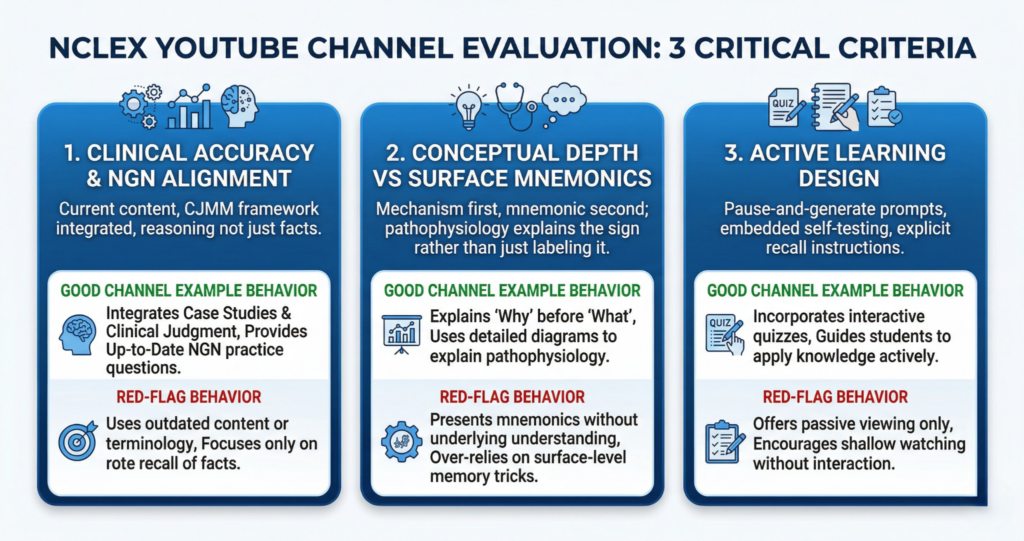
Before evaluating specific channels, establishing the criteria that separate genuinely useful NCLEX YouTube channels from engaging but preparation-ineffective ones makes every subsequent channel comparison more precise.
Clinical Accuracy and NGN Alignment
The most important quality criterion for any NCLEX YouTube channel in 2026 is whether its clinical content is accurate relative to current nursing practice and aligned with the Next Generation NCLEX format. Channels that were built before the NGN launch in 2023 and have not meaningfully updated their content approach are teaching candidates to reason about an exam that no longer exists in the same form. NGN alignment means more than adding a few videos about NGN question types — it means organizing clinical content explanation around the CJMM cognitive skill framework, connecting pathophysiology explanations to the recognize cues and analyze cues reasoning processes, and framing prioritization discussions within the prioritize hypotheses structure that NGN case study questions test. NCLEX YouTube channels whose clinical content is organized around traditional memorization of isolated facts rather than around clinical reasoning frameworks are not preparing candidates for the current exam regardless of how many subscribers they have accumulated.
Conceptual Depth vs. Surface Mnemonics
A second quality criterion distinguishes NCLEX YouTube channels that teach clinical concepts at a mechanistic depth that builds clinical reasoning from those that teach surface mnemonics that aid recognition without developing application. Mnemonics are useful memory tools when the underlying concept is already understood — they reduce retrieval effort for content that is already meaningfully encoded. Mnemonics taught without the underlying conceptual understanding they are supposed to cue produce recognition of the mnemonic label without the clinical reasoning the label is supposed to activate. A channel that teaches the SLUDGE mnemonic for cholinergic crisis symptoms without explaining why acetylcholine excess produces each symptom is teaching surface recognition rather than the pathophysiological understanding that makes the signs derivable rather than memorized. The best NCLEX YouTube channels teach the mechanism first and the mnemonic as a retrieval aid second — which makes the content both more memorable and more applicable under novel clinical scenario conditions.
Active Learning Prompts vs. Passive Viewing Design
The third quality criterion addresses how NCLEX YouTube channels are designed for engagement — whether they prompt active cognitive processing from the viewer or passively present content that the viewer receives without active engagement. Channels designed for active learning include deliberate pause points where the viewer is asked to generate an answer before the explanation is revealed, embedded self-testing questions that require the viewer to stop and think before the correct response is shown, and explicit prompts to close the video and recall what was just learned before continuing. Channels designed for passive viewing present content in a flowing explanatory format that the viewer receives without active generation — which produces the fluency illusion (the content feels familiar and well-understood during viewing) without building the retrieval-ready encoding that the exam requires. The single most important habit for using any NCLEX YouTube channels effectively is pausing after each content section and generating everything remembered from that section from memory before continuing — regardless of whether the channel explicitly prompts this.
The Best NCLEX YouTube Channels in 2026: Channel-by-Channel Analysis
The following channels represent the most consistently valuable and most preparation-relevant NCLEX YouTube channels available for 2026 exam preparation. Each analysis covers content focus, instructional approach, NGN relevance, best-fit candidate profile, and how to use the channel most effectively as a preparation supplement.
RegisteredNurseRN — Best for Comprehensive High-Yield Coverage
RegisteredNurseRN is one of the most established and most comprehensive NCLEX YouTube channels available, with an extensive library covering nearly every content area on the NCLEX test plan organized by body system and clinical topic. The channel’s primary strength is breadth — registered nurses preparing for the NCLEX can find systematic content review videos for cardiovascular, respiratory, neurological, renal, endocrine, pharmacology, mental health, maternal-newborn, and pediatric nursing with consistent visual presentation and clear clinical organization. Instructional videos use clinical diagrams, comparison tables, and systematic presentations that make high-yield content accessible without requiring a textbook. The channel has added content addressing NGN concepts and the CJMM framework, though its core strength remains in traditional content coverage rather than NGN clinical judgment architecture specifically. Best-fit profile for this NCLEX YouTube channel is candidates who need systematic content review across multiple body systems and benefit from visual organized presentation rather than textbook reading. Use it for content review sessions paired immediately with active recall — pause after each video section and generate the clinical content from memory before watching further.
Nurse Liz — Best for Pharmacology and Clinical Reasoning Integration
Nurse Liz has built a following among NCLEX candidates specifically for pharmacology content that is unusually effective — not because the drug facts presented are more comprehensive than other channels but because the instructional approach consistently connects pharmacological mechanisms to the clinical nursing priorities that NCLEX questions actually test. Rather than presenting drug classes as lists of side effects to memorize, Nurse Liz explains why specific side effects occur mechanistically, which among them are the priority nursing assessments, and how clinical scenario questions test the nursing judgment required around that drug class. This mechanism-to-priority approach produces pharmacology understanding that transfers to novel clinical scenarios rather than recognition of familiar drug names. The channel also addresses clinical reasoning frameworks in question-answering strategy videos that are specifically useful for candidates who know the content but struggle to apply it correctly under scenario conditions. Best-fit profile for this NCLEX YouTube channel is candidates whose pharmacology accuracy is below standard and who find traditional drug class memorization ineffective, and candidates who have content knowledge but struggle with clinical reasoning application in pharmacology scenarios specifically.
Simple Nursing — Best for Simplified Concept Explanation
Simple Nursing occupies a specific and valuable instructional niche among NCLEX YouTube channels — it is designed for candidates who find traditional clinical content explanations difficult to follow and who benefit from simplified, plain-language concept explanations that prioritize accessibility over comprehensiveness. The channel’s explanations of complex pathophysiology concepts — heart failure, renal failure, acid-base disorders, endocrine crises — use simplified models, relatable analogies, and visual representations that make the underlying mechanisms more accessible than standard textbook presentations for candidates who have struggled with conceptual comprehension in nursing school. The instructional style is deliberately engaging and uses memory devices integrated with the explanations. The limitation is the simplification itself — for candidates who need deep clinical reasoning development for high-difficulty questions, Simple Nursing provides the conceptual foundation that more advanced clinical reasoning practice must then be built on. Best-fit profile for this NCLEX YouTube channel is candidates whose incorrect answers reflect genuine content comprehension challenges — who read clinical scenarios and do not understand what is happening physiologically — rather than candidates whose comprehension is adequate but whose clinical reasoning application is insufficient.
Nursing School of Success — Best for NGN and CJMM Content
Nursing School of Success has emerged as one of the most NGN-relevant NCLEX YouTube channels for 2026 preparation, with content that specifically addresses the CJMM clinical judgment framework, the five NGN question format types, and the clinical reasoning approach that distinguishes each cognitive skill in the six-skill sequence. The channel provides structured explanations of how to approach unfolding case study questions using the recognize-analyze-prioritize-generate-take action-evaluate sequence, how to identify which CJMM skill each question type is testing from its action verb, and how clinical judgment differs from clinical knowledge as an examination construct. For candidates who understand traditional multiple choice strategies but feel uncertain about how to approach NGN formats specifically, this channel provides the clearest publicly available explanation of the current exam’s clinical judgment architecture. Best-fit profile for this NCLEX YouTube channel is candidates who are familiar with traditional NCLEX content but have limited NGN format preparation, and those who want to understand the CJMM framework before engaging extensive NGN question bank practice.
NursingWithNinja — Best for Visual Learners and Clinical Maps
NursingWithNinja has developed a distinctive instructional approach among NCLEX YouTube channels through its clinical concept mapping and visual clinical reasoning presentation — connecting clinical findings, pathophysiology, nursing assessments, and interventions through illustrated maps that make the causal relationships between clinical elements visible rather than listed. The visual presentation style is particularly effective for candidates who think in visual patterns and who find that clinical concept maps produce stronger long-term retention than text-based clinical notes. Content coverage includes medical-surgical high-yield topics, pharmacology, and mental health nursing with the visual mapping approach applied consistently across all content areas. The limitation is that visual map content works best for candidates who are already oriented to the clinical concepts being mapped — the visual format is a retention and organization tool rather than an initial concept introduction tool. Best-fit profile for this NCLEX YouTube channel is visual learners who have encountered the clinical content in other formats and want to consolidate and organize their understanding through clinical mapping rather than sequential text presentation.
Level Up RN — Best for High-Yield Flashcard Integration
Level Up RN has built one of the most efficiently structured NCLEX YouTube channels for high-yield content review, with videos organized around the Level Up RN flashcard system — each video covering the clinical content corresponding to a set of physical flashcards, with the content presented in a question-and-answer format that naturally prompts active recall during viewing. The call-and-response structure of the videos — the host asks a clinical question, pauses briefly, then answers it — integrates the active recall principle into the viewing experience more deliberately than most NCLEX YouTube channels. Content coverage is comprehensive across all major test plan categories with pharmacology, medical-surgical, maternal-newborn, pediatric, and mental health nursing all well-represented. Best-fit profile for this NCLEX YouTube channel is candidates who want to use free YouTube content paired with the Level Up RN flashcard system as a comprehensive free-and-low-cost preparation strategy, and visual-auditory learners who retain content better through call-and-response active engagement than through sequential explanation videos.
How to Use NCLEX YouTube Channels Actively Rather Than Passively
The most important determinant of whether NCLEX YouTube channels produce preparation value is not which channel is watched but how it is watched. The passive viewing mode — playing videos in the background, watching while doing other things, or watching without note-taking or recall practice — produces at most familiarity with clinical language rather than clinical reasoning development. The active viewing protocol described below converts any high-quality NCLEX YouTube channel into a meaningful clinical reasoning development tool.
The Pause-Generate-Verify Protocol
The pause-generate-verify protocol is the foundational active viewing method for all NCLEX YouTube channels. Before the video begins, identify the clinical concept being covered and generate from memory everything currently known about it — what conditions involve this concept, what the pathophysiology is, what the nursing assessment priorities are. This pre-video generation establishes a baseline and activates the cognitive schema that new information will be integrated into. During the video, pause after each content segment — typically every three to five minutes — and generate from memory what was just presented before the video continues. This pause-generate step interrupts the fluency illusion — the sense that the content is well-understood while it is being presented — by requiring active retrieval rather than passive reception. After the video, close it entirely and generate everything remembered from the full video from memory. Compare the generated content to the video’s content mentally or in notes. The gaps between what was generated and what was presented are the specific encoding failures that a re-watch of specific segments should address.
The Anki Card Creation Rule for Video Content
Any clinical principle encountered in NCLEX YouTube channels that is new, surprising, or clarifying should become an Anki card before the next study activity begins. The front of the card states the clinical scenario prompt that the video’s clinical content addresses: a patient with COPD receives supplemental oxygen at 4 L/min — what is the concern and what is the target saturation? The back states the clinical principle, mechanism, and nursing implication: high-flow O2 in chronic CO2 retainers removes the hypoxic drive, target SpO2 is 88 to 92 percent, titrate oxygen to lowest effective flow. This card format converts the video’s clinical teaching into a retrievable clinical reasoning unit that spaced repetition review consolidates into long-term memory across the preparation period. Five cards per video across three videos per week produces 90 high-yield clinical reasoning cards across a six-week preparation period — a meaningful free supplement to the Anki cards sourced from question bank rationale review.
Pairing Video Content With Same-Day Question Practice
The highest-value integration strategy for NCLEX YouTube channels is the same-day pairing protocol: watch content review videos in the morning or midday and complete 20 to 30 practice questions filtered to the same content area in the evening. This pairing tests whether the video content is accessible under clinical reasoning conditions — whether the mechanism explanation, the pathophysiology framework, or the nursing priority chain can be applied to a clinical scenario question rather than simply recognized when presented in video format. Questions answered incorrectly after a same-day video review reveal the gap between content exposure and clinical reasoning application — the specific points where the video’s instruction did not produce retrievable, applicable clinical knowledge. These gaps, identified through the practice question rationale review, become the highest-priority Anki cards from that session because they represent content that was presented and apparently understood but is not yet clinically applicable.
Integrating NCLEX YouTube Channels Into a Complete Study System
NCLEX YouTube channels are a supplement layer — not a primary preparation system. Understanding precisely where they fit within a complete preparation system and what they are designed to replace versus what they cannot replace prevents the common error of over-relying on video content at the expense of the question bank practice and rationale review that builds clinical reasoning competency.
What YouTube Content Replaces Effectively
NCLEX YouTube channels replace textbook content review most effectively — specifically for candidates who find text-based content review produces lower retention than video-based visual and auditory instruction. A candidate who reads a pharmacology chapter three times and retains less than a candidate who watches a 20-minute pharmacology video once with the active viewing protocol and then completes 15 practice questions has identified that video-first content review is their more efficient preparation modality for content instruction. YouTube also replaces passive re-reading effectively — re-reading notes or textbooks without active recall practice is one of the lowest-return preparation activities available, and replacing re-reading sessions with active-viewing video sessions produces comparable or better content encoding with higher engagement. For candidates who find content review through reading progressively demotivating — a real preparation sustainability issue — NCLEX YouTube channels provide an engagement-maintaining alternative that keeps content review in the weekly schedule rather than disappearing entirely when reading fatigue accumulates.
What YouTube Content Cannot Replace
NCLEX YouTube channels cannot replace two preparation activities that are irreplaceable for clinical reasoning development: question bank practice with full rationale review and timed simulation. No amount of video content builds the specific clinical reasoning competency that answering clinical scenario questions and analyzing wrong-answer rationales develops — these are qualitatively different cognitive activities, and video watching is not a proxy for either one. A candidate who watches 40 hours of NCLEX YouTube channel content across a six-week preparation period without a question bank session is building clinical content familiarity without the clinical reasoning application that the exam tests. Additionally, YouTube content cannot replace the diagnostic function of practice question analytics — identifying specifically which content areas are below the passing standard requires performance data from clinical scenario questions, not from video watching frequency or comprehension during viewing.
The Recommended Weekly Allocation for YouTube Content
The recommended weekly allocation for NCLEX YouTube channels within a complete preparation system is three to five hours per week — approximately 20 to 30 percent of total weekly preparation time in a 15-to-20-hour weekly preparation schedule. This allocation is sufficient to provide meaningful content review and conceptual reinforcement for two to three content areas per week without displacing the question bank practice, simulation, and rationale review that constitute the core preparation activities. YouTube content should be concentrated in the content review portion of each day’s preparation schedule — typically the first 30 to 45 minutes of a study session, followed by the primary question bank practice session. In no week of preparation should YouTube content exceed 30 percent of total preparation time — if it is exceeding that proportion, question bank practice is being displaced rather than supplemented.
Matching NCLEX YouTube Channels to Your Learning Profile
The most effective NCLEX YouTube channels for any individual candidate are those that match their specific learning profile and preparation gap profile rather than those with the highest subscriber counts or the most enthusiastic community reviews. The following matching framework maps candidate situations to the most useful channel combinations.
For Candidates With Content Comprehension Gaps
Candidates whose incorrect answers reflect genuine content comprehension failures — who encounter clinical scenarios and do not understand the underlying physiology well enough to reason through them — should prioritize Simple Nursing for simplified pathophysiology explanation and RegisteredNurseRN for systematic body system content coverage. This combination provides both conceptual accessibility (Simple Nursing) and comprehensive coverage breadth (RegisteredNurseRN). The preparation sequence is Simple Nursing first for any concept where the underlying mechanism is unclear, followed by RegisteredNurseRN for broader coverage within that body system, followed by same-day practice questions testing clinical application of the concepts. NGN format videos from Nursing School of Success should be added after the content comprehension foundation is established — NGN reasoning requires clinical reasoning competency that content comprehension must precede.
For Candidates With Clinical Reasoning Application Gaps
Candidates whose incorrect answers reflect clinical reasoning failures — who understand the content but consistently misapply it in clinical scenario conditions — should prioritize Nurse Liz for the mechanism-to-clinical-priority connection that bridges content knowledge and scenario application, and Nursing School of Success for the CJMM framework that provides the clinical judgment architecture the NGN formats test. These channels address reasoning gaps more directly than content channels because they explicitly connect the clinical content to the decision-making process that NCLEX questions require. This combination should be paired with deliberate reasoning error analysis after each same-day practice question session — using the video content’s reasoning frameworks as the reference point for identifying where clinical logic diverged from the correct answer.
For Visual Learners
Visual learners who retain clinical content most effectively through illustrated diagrams, concept maps, and visual clinical relationships should prioritize NursingWithNinja for clinical concept mapping and Level Up RN for the visual call-and-response format. These two NCLEX YouTube channels provide the highest-quality visual instruction available in the free resource category. The active viewing protocol is especially important for visual learners using these channels — the visual appeal of well-designed concept maps creates a particularly strong fluency illusion, making it feel as though the mapped relationships are well-understood during viewing when they may not be fully encoded. Post-video recall exercises that require reproducing the concept map from memory rather than recognizing it when shown are the most effective active learning activity for visual learners using visual NCLEX YouTube channels.
For Budget-Conscious Candidates Building a Free Preparation Stack
Candidates building a primarily free NCLEX preparation stack should combine RegisteredNurseRN for content review, Nursing School of Success for NGN framework, Level Up RN for call-and-response active practice, and the NCSBN official NGN sample questions at ncsbn.org for authoritative NGN format calibration — paired with Anki for free spaced retrieval review of the clinical principles sourced from all of these channels. This free stack, used with the active viewing protocol and same-day question pairing discipline, provides the content instruction and conceptual organization that paid content courses provide for the portion of preparation allocated to content review. The clinical reasoning practice that the free stack cannot provide — high-quality clinical scenario questions with deep rationale review — requires at minimum a paid question bank subscription, and no combination of NCLEX YouTube channels replaces this component of preparation.
Common Mistakes Candidates Make With NCLEX YouTube Channels
Even well-chosen NCLEX YouTube channels produce minimal preparation value when used incorrectly. The following mistakes are the most common and most costly in terms of preparation time investment without corresponding clinical reasoning development.
Binge-Watching as a Study Session
The most common misuse of NCLEX YouTube channels is binge-watching — spending three to four hours in a single session moving from video to video without pausing, generating recall, or completing same-day practice questions. Binge-watching produces the highest fluency illusion of any preparation activity because the continuous stream of clinical content feels like intensive studying while producing relatively little durable encoding. After a four-hour binge-watching session, the majority of what was presented during hour one is largely inaccessible by the end of hour four — not because the content was not understood during viewing but because encoding without active retrieval practice produces rapid decay. The effective maximum for continuous NCLEX YouTube channels viewing without an active recall interruption is 10 to 15 minutes — the duration of a single video segment before a pause-generate exercise should occur.
Watching Instead of Practicing
The second major NCLEX YouTube channels mistake is using video watching as a substitute for question bank practice on days when practice questions feel effortful or discouraging. Video watching feels like studying — it requires attention, it presents clinical content, it is active enough to feel productive — but it does not build the clinical reasoning that practice question rationale review develops. A week in which four hours of NCLEX YouTube channel content replaced four hours of question bank practice produced less clinical reasoning development than the question bank week would have — because the replacement is between two activities that are not equivalent in their preparation function. Video content supplements question practice; it does not replace it. If a day of preparation produces no practice questions because all available study time went to video watching, the day’s preparation was less effective than if video time had been limited to 30 to 45 minutes and the remaining time allocated to question practice.
Not Verifying Content Currency
NCLEX YouTube channels accumulate libraries of older content that may not reflect the current NGN exam format, updated clinical guidelines, or the current NCSBN test plan. A video published in 2021 or 2022 that presents NCLEX question strategies, content coverage priorities, or test plan weightings is providing information about a different examination than the one currently administered. Before relying heavily on any video’s strategic guidance — particularly videos about what topics are most important, how the exam works, or how to approach question types — check the publication date. Clinical pathophysiology content is less date-sensitive than NCLEX strategy content, but pharmacology guidelines and clinical practice standards can change meaningfully within three to five years. The most reliable currency check for NCLEX YouTube channels strategy content is confirming that the video explicitly references the NGN format and the CJMM framework — channels that do not reference these are almost certainly presenting pre-2023 exam guidance.
- Red flag: videos that promise shortcuts. Any NCLEX YouTube channel video that promises to teach you everything you need to pass in under two hours, or that claims a specific approach guarantees passing, is presenting marketing rather than preparation guidance. Clinical reasoning competency is not shortcuttable to a video runtime.
- Red flag: content organized by test-taking tricks. Videos organized around answer elimination tricks, rule-based option selection strategies, or NCLEX pattern recognition techniques without clinical reasoning foundation are teaching candidates to navigate around clinical judgment rather than to develop it — which is precisely what the NGN format redesign was intended to make ineffective.
- Red flag: community popularity over content quality. High subscriber counts and enthusiastic community reviews are reliable indicators of engaging presentation style, not of clinical accuracy, NGN alignment, or preparation effectiveness. Evaluate NCLEX YouTube channels against the three quality criteria — clinical accuracy and NGN alignment, conceptual depth versus surface mnemonics, and active learning design — rather than against social proof metrics.
Conclusion
NCLEX YouTube channels represent a genuine and valuable free preparation supplement when chosen for clinical accuracy and NGN alignment, used with the active viewing protocol rather than passively, allocated no more than 20 to 30 percent of weekly preparation time, and integrated with same-day question pairing that tests whether video content transfers to clinical reasoning application. RegisteredNurseRN provides the broadest content coverage. Nurse Liz provides the strongest pharmacology reasoning integration. Simple Nursing provides the most accessible pathophysiology explanations. Nursing School of Success provides the clearest NGN and CJMM framework instruction. NursingWithNinja provides the highest-quality visual concept mapping. Level Up RN provides the most active call-and-response engagement structure.
None of these NCLEX YouTube channels replace a quality question bank with deep rationale review, and none build the clinical reasoning competency that only clinical scenario practice develops. They build the clinical content foundation and conceptual organization that clinical reasoning practice then develops into exam-ready competency — which is a valuable function that justifies their place in a complete preparation system when used correctly. Watch actively, generate before resuming, create Anki cards from new clinical principles, pair with same-day practice questions, and keep the total allocation within a supplement proportion rather than allowing video content to displace the core activities that determine the exam result.
