

NCLEX study techniques that produced reliable first-attempt passing results for nursing students a decade ago are increasingly unreliable for students preparing in 2026 — not because those techniques were ever flawed in principle, but because the examination they were calibrated to measure has changed in ways that make the same techniques less effective against the current format. This is a story about the relationship between an examination’s design and the study methodology that examination rewards — and about how a significant design change in 2023, expanded further in 2026, has shifted what counts as effective preparation more substantially than most candidates realize.
Before 2023, NCLEX study techniques optimized for high-volume question exposure and content review produced strong results because the examination’s single-best-answer multiple choice format rewarded exactly the pattern recognition and content recall that those techniques developed. A nursing student who read review books thoroughly, completed several thousand practice questions, and built broad content familiarity was well-matched to an examination that tested whether that content familiarity could be applied to recognizably-patterned clinical scenarios. The Next Generation NCLEX changed this relationship. The clinical judgment measurement model that now governs a substantial and growing proportion of exam questions measures a different cognitive skill than pattern recognition — sustained reasoning through developing clinical narratives, independent option evaluation under partial credit scoring, and explicit application of a formal six-skill cognitive framework. NCLEX study techniques that do not specifically address this different cognitive skill are decreasingly effective relative to the examination’s current demands, even when applied with the same diligence and volume that made them effective for previous cohorts.
This guide traces the specific ways the examination has changed, what those changes mean for which traditional NCLEX study techniques remain effective and which require modification, and what the current study methodology looks like when it is built around what the 2026 examination actually measures rather than around inherited assumptions about what NCLEX preparation requires.
How the Examination Changed: A Brief History of What Shifted
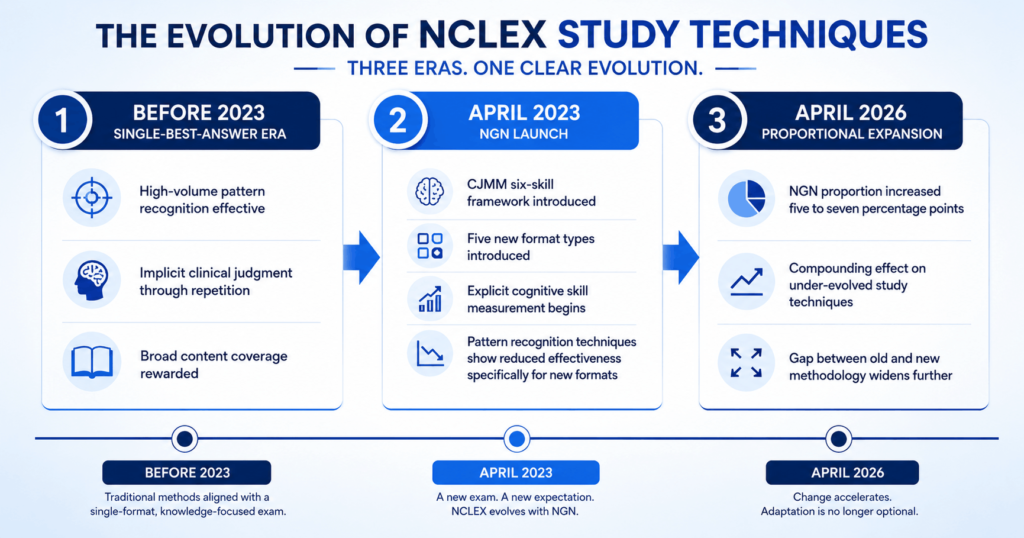
Understanding why NCLEX study techniques have needed to change requires understanding precisely what changed in the examination itself — because the study methodology shift is a direct response to a measurement shift, not an arbitrary preparation trend.
Before 2023: The Single-Best-Answer Era
From the introduction of computerized adaptive testing in the 1990s through 2023, the NCLEX measured clinical judgment almost entirely through single-best-answer multiple choice questions. This format, while genuinely requiring clinical reasoning to answer correctly, allowed a specific category of NCLEX study techniques to be highly effective: high-volume question bank practice that built pattern recognition between clinical scenario presentations and correct nursing actions. A nursing student who practiced thousands of questions developed an implicit, accumulated sense of how clinical scenarios map to correct answers — and this implicit pattern recognition, even without highly explicit framework instruction, produced strong NCLEX performance for the format that existed before 2023. The NCLEX study techniques optimized for this era emphasized volume, repetition, and broad content coverage because the examination format rewarded exactly those preparation investments.
April 2023: The Next Generation NCLEX Launch
The Next Generation NCLEX launched in April 2023 with the NCSBN’s Clinical Judgment Measurement Model — a formal six-skill framework (recognize cues, analyze cues, prioritize hypotheses, generate solutions, take action, evaluate outcomes) and five new question formats designed to measure each skill more directly than single-best-answer questions could. This was not a cosmetic format change. It represented a fundamental shift in what the examination measures: from clinical judgment as an implicit, holistic competency demonstrated through correct answer selection to clinical judgment as an explicit, decomposable set of cognitive skills that can be individually measured, individually taught, and individually practiced. NCLEX study techniques that had been effective for the single-best-answer era began producing measurably weaker results for the NGN format specifically — not because the underlying clinical knowledge requirements changed, but because the cognitive skill of sustained narrative reasoning across an unfolding case study set is different from and only partially overlapping with the pattern recognition skill that high-volume single-question practice develops.
April 2026: The Proportional Expansion
The April 2026 test plan update did not introduce new format types, but it increased the proportion of NGN format questions within the adaptive item pool by approximately five to seven percentage points relative to the 2023 launch proportion — a change that further reduced the effectiveness of NCLEX study techniques calibrated to the pre-2023 single-best-answer format. A preparation approach that allocated minimal time to NGN-specific practice produced a smaller performance penalty in 2023 and 2024, when NGN items represented a smaller proportion of the average exam session, than it does in 2026, when the proportion has increased. This is the specific mechanism by which the examination’s evolution has compounded over three years: each test plan cycle has incrementally increased the cognitive judgment measurement proportion of the exam, and NCLEX study techniques that do not evolve correspondingly fall further behind the examination’s actual demands with each cycle.
Which Traditional NCLEX Study Techniques Still Work

Not everything about pre-2023 NCLEX study techniques has become obsolete — several core techniques remain as effective as they have always been because they address dimensions of clinical reasoning that the format change did not alter.
Full Rationale Review Remains the Highest-Value Technique
The single most important NCLEX study technique — completing full, analytical rationale review on every practice question rather than checking the correct answer and moving on — has not been diminished by the NGN transition. If anything, it has become more important, because NGN format rationale review requires the additional step of identifying which CJMM cognitive skill the question tested and whether the error (if any) was a content gap or a skill application gap. The fundamental principle that rationale review extracts more clinical reasoning value than question volume alone remains exactly as true in 2026 as it was in 2010. This technique transcends the format change because it addresses how clinical reasoning principles are extracted and consolidated from practice experience — a process that is independent of whether the question is traditional multiple choice or an NGN format type.
Spaced Repetition and Active Recall Remain Foundational
Memory science principles — spaced repetition for long-term retention, active recall over passive review, and the testing effect that strengthens memory through retrieval practice rather than re-reading — are not specific to any examination format and remain exactly as effective for NCLEX study techniques in 2026 as they were for any previous cohort. The clinical reasoning principles that NGN format practice teaches still need to be consolidated into long-term retrievable memory through the same spaced repetition mechanisms that traditional content always required. What has changed is not whether spaced repetition works, but what content the spaced repetition system needs to include — clinical reasoning chains extracted from NGN-specific rationale review now belong in the same Anki deck as traditional content principles, reflecting the broader range of clinical reasoning skill the current examination requires.
The Three-Tier Priority Framework Is More Important, Not Less
The ABCs-then-Maslow-then-nursing-process priority framework that has organized NCLEX clinical reasoning since long before the NGN transition remains not just valid but more central to NCLEX study techniques in 2026 than before — because the NGN’s prioritize hypotheses cognitive skill is essentially a direct, explicit test of this same framework applied within an unfolding clinical narrative rather than a single static question. Students whose NCLEX study techniques have always emphasized deep framework internalization rather than memorization of specific clinical facts find that this preparation investment transfers more completely to the NGN format than content-memorization-heavy approaches do, because the framework is what generalizes across both traditional and NGN question types.
Which NCLEX Study Techniques Need to Change
Several once-effective NCLEX study techniques now produce measurably weaker results against the current examination format — not because the techniques were poorly designed, but because they were calibrated to a measurement target that has shifted.
Pure Volume Accumulation Without Format Differentiation
The NCLEX study technique of simply accumulating high question volume — completing as many practice questions as possible across the preparation period — has become measurably less effective when that volume is not deliberately differentiated by format type. A student completing 3,000 traditional multiple choice questions and almost no NGN-specific practice is building a skill profile that increasingly diverges from what the 2026 examination measures, because the proportion of the exam testing skills that volume builds (pattern recognition) relative to skills it does not build (sustained narrative reasoning, partial credit response strategy) has shifted toward the latter. The technique of pure volume accumulation needs to evolve into volume accumulation with deliberate format allocation — 30 to 35 percent NGN content as a built-in proportion of every practice session rather than an occasional supplementary activity.
Standalone Question Practice Without Case Integration
A specific NCLEX study technique that has become actively counterproductive for a meaningful portion of the exam is practicing NGN questions as standalone items extracted from their case context — a technique that question bank platforms sometimes encourage by allowing filtering to individual NGN item types without requiring full case set completion. This approach builds partial credit response mechanics without building the case integration skill — carrying forward an accumulating clinical picture across six sequential questions — that the unfolding case study format specifically and most heavily tests. NCLEX study techniques need to evolve to require full six-question case set completion as a standard practice unit, with the carry-forward protocol (reviewing what previous questions in the set established before approaching each subsequent question) as an explicit step rather than an optional refinement.
Generic Test-Taking Strategies Without Skill-Specific Calibration
Generic test-taking strategies that previous cohorts relied on — eliminating obviously wrong answers, looking for qualifying words, selecting the most comprehensive-sounding option — were always secondary to genuine clinical reasoning but provided some marginal benefit under single-best-answer conditions where four or five options needed to be narrowed to one. These generic strategies provide substantially less benefit under NGN partial credit conditions, where the optimal response strategy is independent criteria evaluation of each option rather than comparative elimination across a small option set. NCLEX study techniques that have relied on generic test-taking strategy as a meaningful preparation component need to replace that component with the CJMM action verb identification habit and the independent criteria evaluation practice that the current format specifically rewards.
The New NCLEX Study Technique: Explicit Cognitive Skill Practice
Beyond modifying existing techniques, the current examination rewards an entirely new category of NCLEX study technique that did not have a clear equivalent before the NGN transition: explicit, deliberate practice of each individual CJMM cognitive skill as a distinct trainable competency.
Why Explicit Skill Practice Is Genuinely New
Before the CJMM framework existed as an explicit measurement model, nursing students developed clinical judgment implicitly — through accumulated clinical content study and practice question exposure that built holistic reasoning ability without ever decomposing that ability into named, individually practiced components. The CJMM’s formal articulation of six distinct cognitive skills creates the possibility of an NCLEX study technique that did not previously exist in this explicit form: practicing recognize cues as a skill independent of analyze cues, practicing prioritize hypotheses as a skill independent of generate solutions, and identifying through deliberate rationale review which specific skill, among the six, produced an error when an answer is incorrect. This skill-decomposed practice approach is genuinely new because the framework that makes the decomposition possible did not exist in this explicit form before 2023.
How to Practice Skill-Specifically
The practical implementation of explicit cognitive skill practice as an NCLEX study technique involves identifying the action verb in every NGN question before reading any answer option, naming which of the six CJMM skills that action verb indicates, and after completing the rationale review, confirming whether the error (if the answer was incorrect) was a content-level error or a skill-application error — selecting the wrong cognitive process for the question rather than lacking the clinical knowledge the question required. Tracking these skill-application errors separately from content errors in the weekly error log reveals patterns that neither traditional content-focused rationale review nor pure question volume would surface: a student might discover, for example, that their errors cluster specifically around the prioritize hypotheses skill — consistently selecting the most probable clinical explanation rather than the most urgent one — a pattern that is a reasoning habit correctable through deliberate practice rather than a content gap requiring more review.
Building a Skill-Specific Practice Rotation
A complete implementation of the explicit skill practice NCLEX study technique includes a weekly rotation that ensures deliberate attention to each of the six CJMM skills rather than allowing question bank randomization to determine which skills get practiced. Dedicating specific practice sessions to question sets filtered by cognitive skill type where the question bank platform allows this filtering, or manually tracking which skill each completed NGN question tested across a week’s practice to identify any skill receiving disproportionately little practice, ensures that all six skills receive deliberate attention rather than only the skills that happen to appear most frequently in randomly selected practice sets. This skill-specific rotation is the most direct NCLEX study technique response to the explicit, decomposable nature of the CJMM framework — treating clinical judgment as six practicable components rather than one holistic and less trainable competency.
What This Means for How You Should Study Starting Today
Translating the historical shift in the examination into a concrete preparation methodology produces a specific, actionable NCLEX study technique framework for any candidate beginning or continuing preparation in 2026.
The Integrated Study Session
The current best-practice NCLEX study technique structures every practice session as an integrated unit rather than separating traditional and NGN practice into different activities. A single 60 to 90 minute session includes mixed-format questions (65 to 70 percent traditional, 30 to 35 percent NGN with at least one full unfolding case study set), full four-question rationale review for every question, dual-track error classification (content error versus skill-application error for NGN items), and Anki card creation from the session’s most important clinical reasoning principles regardless of which format taught them. This integration reflects the reality that the current examination does not separate traditional and NGN content into different sections — the adaptive algorithm selects from the full item pool continuously — and preparation that mirrors this integration produces more transferable readiness than preparation that treats the two formats as separate study tracks.
The Updated Weekly Audit
The weekly micro-audit that NCLEX study techniques have long used to track preparation progress needs one specific addition for the current examination: tracking the six CJMM skills’ individual error rates alongside the traditional content category breakdown. A complete 2026 weekly audit reviews overall accuracy trend, content category accuracy with no category below 50 percent, NGN format accuracy tracked separately from traditional accuracy, and now also the distribution of errors across the six cognitive skills to identify any skill-specific pattern that a content-only audit would miss. This additional tracking dimension is the direct preparation management response to the examination’s decomposed measurement model — auditing preparation at the same level of granularity that the examination itself measures performance.
Trusting the Technique Evolution Without Abandoning the Fundamentals
The most important orientation for any nursing student adapting their NCLEX study techniques to the current examination is recognizing that this is technique evolution, not technique replacement. The fundamentals that have always mattered — quality rationale review, spaced repetition consolidation, deep framework internalization, consistent timed practice — remain exactly as important as they have ever been. What has changed is the addition of explicit NGN format integration, skill-specific error tracking, and case set completion as standard practice requirements layered onto the same fundamental preparation principles. Students who understand this as addition rather than replacement avoid the mistake of abandoning proven techniques in pursuit of NGN novelty, while also avoiding the mistake of clinging to pre-2023 techniques without the updates the current examination requires.
- The single most important technique update for any NCLEX study plan in 2026: Stop practicing NGN questions as standalone items. Complete full six-question unfolding case study sets with the carry-forward protocol applied between every question. This single change addresses the most significant skill gap between pre-2023 and current preparation approaches and produces measurable NGN accuracy improvement faster than any other single technique adjustment.
- How to update an existing NCLEX study routine without starting over: Keep your existing daily rationale review, spaced repetition, and timed practice habits exactly as they are. Add three specific layers: 30 to 35 percent NGN content in every session, CJMM action verb identification before every NGN option, and skill-specific error classification alongside your existing content error classification. These additions integrate into an established routine without requiring you to discard techniques that are already working.
- Where to verify that your study techniques match the current examination: The NCSBN’s official NGN sample questions and CJMM documentation at ncsbn.org are the most reliable reference for confirming that your practice technique matches the current examination’s actual measurement model. Complete the official samples using the integration and skill-identification techniques this guide describes, and compare your experience against how you have been practicing NGN content in your regular question bank — discrepancies reveal exactly which technique adjustments your routine still needs.
Conclusion
NCLEX study techniques have needed to evolve because the examination they prepare candidates for has evolved — from a single-best-answer format that rewarded pattern recognition through high-volume practice to a clinical judgment measurement model that explicitly decomposes reasoning into six trainable cognitive skills and tests them through formats that reward sustained narrative integration and independent criteria evaluation rather than comparative elimination. This is not a story of old techniques being wrong. It is a story of an examination’s measurement target shifting and study methodology needing to shift correspondingly to remain effective against that target.
The techniques that have always mattered — full rationale review, spaced repetition, deep framework internalization, consistent timed practice — remain exactly as essential in 2026 as they have ever been. What needs to change is the addition of deliberate NGN format integration with full case set completion, explicit skill-specific practice and error tracking across the six CJMM cognitive skills, and the replacement of generic test-taking strategies with independent criteria evaluation calibrated to partial credit scoring. Students who update their NCLEX study techniques to reflect these additions — without abandoning the fundamentals that continue to work — are studying for the examination that actually exists in 2026, not the examination that existed before the format evolved.
